
Jean-Pierre Saad
Related Articles

Democracies have always faced disagreement. In fact, disagreement is what makes their strengths: people can argue, vote, protest, criticize leaders, and imagine different futures. Yet, today, in many democratic societies, political disagreement feels less like debate and more like identity conflict. People do not simply disagree with the other side; they often distrust it, fear it, or see it as morally dangerous. This is why democracies seem more polarized today. One major reason is that politics have become deeply tied to identity. In the past, citizens might have disagreed mainly on taxes, foreign policies, or public services. Today, political positions are often associated with religion, education, geography, social class, gender, culture, and even lifestyle. A vote no longer feels like a choice between two policies: it can feel like a defense of “who we are.” When politics becomes identity, compromise becomes harder since it can feel like betrayal.
Another factor is the upsurge of media exposure. Social media led political opinions to be expressed faster, louder, and in a more emotional way. Algorithms often reward content that triggers anger, fear, or shock. In fact, this type of content keeps people engaged. A systematic review of research on media and polarization found that media matching people’s prior views can intensify polarization [1]. Instead of encountering a shared public conversation, citizens tend to live in separate information worlds. In other words, each side lives within its own facts, heroes, scandals, and enemies. Economic insecurity also plays an important role. When people feel that their future is unstable, that the prices are rising, or that the opportunities are shrinking, they become more receptive to political messages that blame an enemy. The “enemy” may be immigrants, elites, corrupt politicians, foreign powers, or another social group. Polarization grows when frustration is redirected into resentment.
Trust is another key issue. The OECD’s 2024 Trust Survey, based on nearly 60,000 people across 30 countries, examined how citizens’ experiences with government shape trust in public institutions [2]. When people lose trust in institutions, they become more likely to believe that the system is rigged, that the elections are unfair, or that the opponents are not legitimate. Therefore, instead of accepting the defeat, they tend to wait for the next elections to dominate again.
Finally, polarization may appear stronger today because democratic life is more visible than ever. In the past, the disagreements were limited in newspapers’ texts, parliaments, universities, or within private conversations. Nowadays, every controversy can be recorded, posted, shared, commented on, and transformed into a national or even a global debate within minutes. Citizens are no longer exposed only to the conflicts within their own society; they are constantly witnessing political tensions from other countries as well. This continuous exposure can create the feeling that democracy is permanently in crisis, even when disagreement is a normal aspect of a democracy.. However, polarization does not mean that democracy is doomed. Rather, it shows that democracy needs to be reshaped and renewed.. The problem is not the disagreement itself, because democracy relies on disagreement. The real danger appears when disagreement turns into hostility. This occurs when citizens stop seeing their opponents as people with different ideas, but start seeing them as enemies who must be defeated at any cost.
This is why rebuilding democratic culture is essential. Stronger civic education can teach people how institutions work, why pluralism matters, and how to debate without hatred. Responsible media use can help citizens become more aware of manipulation, misinformation, and emotionally charged content. Transparent institutions can also rebuild trust by showing that political decisions are made fairly and that leaders are accountable. Just as importantly, societies need spaces where people meet outside political labels: schools, universities, workplaces, local associations, cultural events, and community initiatives. These spaces remind people that they may disagree politically while still sharing daily concerns, hopes, and responsibilities. In the end, democracy does not require everyone to think alike. It requires citizens to accept that disagreement is legitimate and that opponents are still citizens, not enemies. Preserving that belief may be one of the most urgent democratic challenges of our time.
References:
[1] Kubin et al 2021, The Role of (Social) Media in Political Polarization: A Systematic Review
[2] OECD Survey on Drivers of Trust in Public Institutions - 2024 Results
Why Do Democracies Seem More Polarized Today?
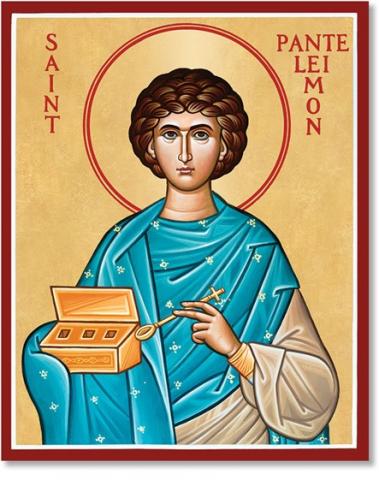
St. Panteleimon is one of the most venerated physician-saints in the Orthodox church, known for uniting medical knowledge with deep spiritual compassion. Born in the late third century in Nicomedia, St. Panteleimon was originally named Pantaleon and trained as a physician under the imperial court of Emperor Maximian. His early life was shaped by a dual influence: a pagan father and a Christian mother, whose faith would later play a decisive role in his conversion.
Pantaleon’s transformation began through his encounter with the priest Hermolaus, who introduced him to Christianity. According to tradition, his faith was solidified after he invoked the name of Christ to heal a blind man, an act that not only restored physical sight but also symbolized spiritual illumination. From that moment, he devoted himself entirely to Christ, adopting the name Panteleimon, meaning “all-merciful”, reflecting both his faith and his vocation.
What distinguishes St. Panteleimon is his role as an “unmercenary physician,” a title given to saints who offered healing pro bono, without accepting any sort of payment. In a society where medicine was often reserved for the wealthy, Panteleimon treated the poor, prisoners, and marginalized, embodying a radical ethic of charity. His practice was not limited to physical healing; it was understood as a continuation of Christ’s healing ministry, addressing both bodily illness and spiritual suffering.
This dual role is visually expressed in Orthodox iconography, where St. Panteleimon is typically depicted holding a small wooden box and a spoon. The wooden box represents his medical kit, containing remedies and instruments used in healing. It signifies his identity as a trained physician and his practical engagement with medicine. The spoon, on the other hand, is more symbolic. While it may suggest the administration of medicine, it is also often interpreted in a liturgical context, resembling the spoon used in the Eucharist. This connection emphasizes that Panteleimon’s healing extended beyond the physical to the sacramental and spiritual realm. In this way, the icon portrays him not merely as a doctor, but as a mediator of divine grace.
His growing reputation as a healer and Christian eventually led to his persecution. During the Diocletianic persecutions (persecutions done against Christians under Emperor Diocletian), he was denounced for his faith and subjected to various forms of torture. Despite the attempts made to execute him, tradition recounts miraculous survival, reinforcing the belief that his healing power was divinely granted. He was ultimately martyred, sealing his witness with his life.
St. Panteleimon’s legacy lies in this synthesis of science and faith. He represents a model in which medical knowledge is not opposed to religious belief but is elevated by it. His life challenges the separation between professional skill and moral responsibility, presenting medicine as a vocation grounded in compassion, humility, and service.
Thus, the image of St. Panteleimon holding his box and spoon is not incidental but deeply theological. It encapsulates his identity as both physician and saint, one who healed the body through knowledge and the soul through faith, embodying the Orthodox ideal of holistic healing.
St. Panteleimon: Medicine as an Act of Faith and Charity
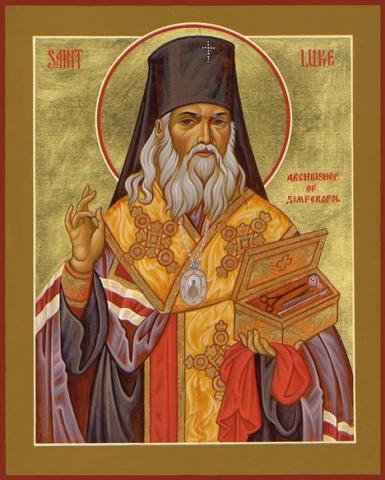
Saint Luke, born Valentin Felixovich Voino-Yasenetsky in 1877 in Crimea, led a life that uniquely united science, compassion, and deep Christian faith. Although he showed early talent in painting, his profound concern for human suffering urged him to pursue medicine instead. He graduated from the Medical Faculty of Kiev University in 1903 and quickly came to be regarded as an exceptionally skilled surgeon, especially in the field of purulent (infectious) surgery.
During the first years of his medical career, Valentin worked in rural hospitals and military medical units, where he treated the poor with remarkable devotion. He married Anna Vasilievna, a nurse who shared his spirit of service, with whom he raised four children. After Anna’s death in 1919, his vocation took a spiritual turn that would shape the rest of his life.
In 1921, he was ordained a priest, and consecrated as a bishop two years later with the monastic name Luke, honoring the Apostle Luke, the physician-evangelist. From that moment on, he carried two callings simultaneously: he remained a surgeon and professor of medicine while also serving as a pastor during a time of intense religious persecution in the Soviet Union. One of the most striking examples of this dual commitment was his insistence on keeping an icon of the Virgin Mary in the operating room. He famously declared that he would never operate without her presence, saying that surgery requires not only skill and knowledge but also divine guidance. This conviction became a hallmark of his medical practice and spiritual identity.
Saint Luke endured three arrests, interrogations, and years of exile in Siberia, where he faced harsh conditions, hunger, and threats. Yet he continued to perform surgeries, even in exile, often operating with limited tools in remote villages. He also authored a widely acclaimed medical textbook, "Essays in Purulent Surgery," which would later earn him the Stalin Prize for outstanding scientific contribution, despite being a persecuted clergyman.
During World War II, he was appointed chief surgeon in a military hospital, saving thousands of wounded soldiers. After the war, he became Archbishop of Simferopol and Crimea, where he continued to serve the Church and treat patients, even when glaucoma left him nearly blind. Known for his gentleness, courage, and unwavering integrity, he comforted the sick and defended Christian teachings in the face of government opposition.
Saint Luke died on June 11, 1961. His funeral drew enormous crowds, and people openly sang hymns in defiance of Soviet authorities. In 1996, he was canonized by the Russian Orthodox Church, and today his relics in Simferopol attract pilgrims from around the world. Numerous healings and miracles are attributed to his intercession.
Saint Luke’s life stands as a compelling testament to the harmonious coexistence of science and faith. He showed that a physician can heal not only the body but also the soul, and that courage, love, and service can shine even in the darkest times.
Saint Luke the Archbishop of Simferopol: A Life of Faith and Healing

Lebanon has long struggled with implementing meaningful reforms, despite having formal legal frameworks and institutions designed to support change. The problem is not primarily a lack of laws or technical expertise, but a political culture that prioritizes short-term interests, patronage, and sectarian bargaining over effective governance. This mindset has consistently turned opportunities for reform into acts of obstruction, leaving the state incapable of responding adequately to social, economic, and institutional challenges.
The Lebanese Constitution and legislative system provide mechanisms through which reforms can be proposed, debated, and enacted. Over the decades, proposals have been put forward to modernize the judiciary, regulate the banking sector, improve public services, and strengthen transparency in government. In theory, these frameworks allow the state to adapt to the evolving social and economic needs. In practice, however, reform initiatives frequently stall or are diluted during implementation, not because of technical deficiencies but because of political incentives that reward inaction and manipulation.
One major factor inhibiting reform is the entrenched logic of clientelism. Political actors often rely on networks of patronage to maintain power, distribute resources, and secure loyalty. Any reform that threatens these networks is viewed as a potential loss of influence. Laws and regulations intended to promote transparency, meritocracy, or efficiency are therefore selectively enforced or ignored, while reforms that do not interfere with political interests are rarely prioritized. This creates a culture in which legal rules exist more as formalities than as binding instruments of accountability.
Sectarianism further complicates the implementation of reforms. Although not codified in legislation, informal sectarian agreements dictate political behavior, from ministerial appointments to parliamentary voting. These agreements often take precedence over institutional efficiency, turning potentially straightforward reform processes into complex negotiations among factions. As a result, even technically sound proposals may fail because they upset informal balances of power, rather than being legally flawed.
The consequences of this failure are profound. Economic mismanagement, infrastructure collapse, and weakened public institutions are all exacerbated by the inability to enact reforms. Citizens experience every day the consequences of a system in which political maneuvering outweighs legal mandates, fostering frustration and eroding trust in state institutions. Moreover, repeated failures to reform strengthen the perception that change is impossible, perpetuating cycles of stagnation and institutional paralysis.
In conclusion, the failure of reform in Lebanon is a product of political culture rather than a constitutional or technical incapacity. Patronage, sectarian bargaining, and the prioritization of personal or factional interests over public duty systematically undermine legal and institutional mechanisms designed to enable change. Without a fundamental shift in political mentality toward accountability, compromise, and prioritization of national interest, reforms will continue to be proposed but rarely realized, leaving the state structurally incapable of responding to the challenges it faces.