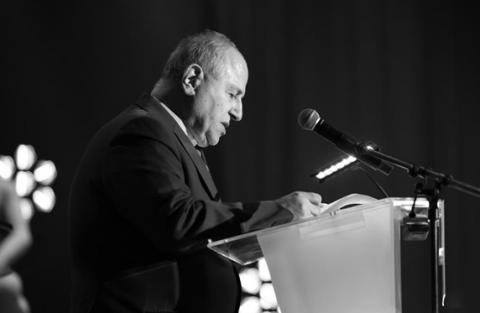
On April 16, 2026, Saint Joseph University of Beirut (USJ) held its annual celebration of Jesuit Week at its Sciences and Technology Campus, located in Mar Roukoz. Initially planned for March, the event was rescheduled due to the regional security situation. Nevertheless, on this Thursday afternoon, the long-awaited ceremony took place at the Jean Ducruet Amphitheater, attended by cultural, religious, and academic figures.
This year’s Jesuit week was unlike the others since it was a tribute to a man who has been a central figure of the University for more than a decade: Reverend Father Salim Daccache, Rector of Saint Joseph University from 2012-2025, honoring an educational journey marked by intellectual and humanistic contributions through hurdles and difficulties and an ever-changing educational landscape. Professor Daccache first integrated Saint Joseph University in 2008, taking up the mantle of Dean of the Faculty of Religious Studies. Then, he was appointed Rector of the University in 2012 and led the University for more than 13 years before choosing to retire to dedicate himself to research.
Held under the theme of “Every person and the whole person” (Tout homme et tout l'homme), a nod to Reverend Daccache’s personal philosophy, the event reflects the long-held Jesuit tradition of cultivating the whole person and reaffirming the importance of education in shaping the human spirit, allowing him to live and flourish in dignity. The ceremony was marked by a series of speeches, all casting light on Father Daccache’s pivotal role in the University’s development, particularly in enhancing the quality of education while embodying Jesuit values of service, openness, and dialogue. The audience was also treated to a musical performance by Charbel Rouhana and his troop, with the “Oud” at the heart of the performance, an instrument greatly appreciated by Pr. Daccache.
Though, the highlight of the evening was the projection of a documentary, produced by two alumni of the University, Cynthia Bou Zeid (IESAV, 2013) and Philippe Bou Zeid (ISP, 2007), retracing the life of father Daccache: from his ordaining as priest at the Ghazir Seminary to his academic and administrative role at USJ, while also showing the more human side of him through the testimony of those who worked under him. The film painted the picture of a man who stood firm in his ideals, even amid some of Lebanon’s worst crises, from the economic crises to the port explosion and the recent war, he never wavered and stayed true to his ideals, putting himself at the service of others in these difficult times and doing his best to foster an environment of intellectual and cultural pursuit, in the ruins of a collapsed country. Thanks to his visionary and intuitive leadership, the Saint Joseph University of Beirut remained resilient and steadfast in the face of adversity.
Despite everything, Pr. Salim Daccache proved himself to be a true pillar of the institution. Never faltering despite the unending national crises, he guided the institution through uncertain times with steadiness and devotion. To him, USJ was far more than an institution; it was a community in its own right. This tribute wasn’t just the celebration of a person but the closing of a defining chapter in the University’s history, one of resilience, leadership, and growth against all odds, as well as the beginning of a new one.