

Andrew Zgheib
Related Articles
The title may already sound confusing. We are usually taught that, in order to prove something, we must provide evidence. To prove that we know something, we need to explain it. To prove that we possess an object, we need to show it, and so on. In the world of cybersecurity – specifically cryptography – we can sometimes avoid revealing that evidence.
Before explaining why this mechanism is useful, let’s illustrate it through an example. Suppose you want to prove to your friend that you have drawn a red card from a standard 52-card deck, without revealing which specific card it is. Your friend watches you draw a card at random, but you keep it face down so they cannot see it.
To prove your claim, you take the remaining 51 cards and show all 26 black cards one by one, placing them face up on the table. Since a standard deck contains exactly 26 black cards, and all of them have been accounted for, your friend can conclude that your hidden card must be red.
In this way, your friend only learns the color of the card, without gaining any information about its rank or suit.
This is the essence of a Zero-Knowledge Proof (ZKP). First introduced by Shafi Goldwasser, Silvio Micali, and Charles Rackoff in 1985, ZKPs allow a prover to convince a verifier that a statement is true without revealing any information beyond the validity of that statement.
For ZKPs to be valid, three fundamental properties must be satisfied:
1. Completeness: If the statement is true, an honest prover will always be able to convince the verifier.
2. Soundness: If the statement is false, no dishonest prover can convince the verifier (except with a very small probability).
3. Zero-Knowledge: If the statement is true, the verifier learns nothing other than the fact that the statement is true.
On one hand, one key application of ZPKs that showcases its importance is the rise of blockchain technology and decentralization. Transaction records are visible to everyone on public ledgers, which can potentially expose financial data. In some systems, ZKPs allow multiple transactions to be grouped and verified together, improving efficiency while preserving privacy.
On the other hand, governments could issue digital credentials that allow citizens to vote, claim benefits, or travel, while proving eligibility without revealing sensitive personal details.
Technology is still evolving, and the mathematical complexity required to generate these proofs remains significant. However, as our computing power grows and the need for privacy becomes more pressing, ZKPs may become a core component of our digital interactions. In an increasingly uncertain digital world, mathematics might be the only thing left that doesn't lie.
Proving You Know a Secret Without Revealing It
The dark web is often described as a lawless underworld, and in many corners that image is accurate. Stolen credentials, personal data, illegal trades, and way more lure daily in the shadows. Yet the same place that conceals wrongdoing also shelters whistleblowers, dissidents, and journalists. Darkness, in this case, is both refuge and incubator.
Fearing the dark web is the easiest response. Curiosity with a backbone is more useful. The dark web hides items you never knew were taken. If your email and social accounts were part of a leak, an intruder may already know more about you than your neighbors do. They can craft messages that feel unsettlingly personal, open accounts in your name, or sell your identity to someone else.
However, the danger is not always dramatic. It is often quiet and patient in the way small pieces of data gradually build a portrait of you. Your birthday here, a subscription there, a forgotten data breach that resurfaced years later… Combined, those fragments can give birth to fraud, social engineering, and targeted scams. Corporations are victims too through leaked employee records and proprietary code. This can mean financial catastrophes and a loss of reputation.
However, you don’t need to become paranoid to be prepared. Start with the obvious: unique, strong passwords securely stored, multi-factor authentication, and a habit of updating your devices and applications. Treat unknown links and public Wi-Fi like a crowded marketplace where pickpockets are waiting for the second you slip.
The dark web will not disappear, nor should it, because it sometimes serves vital functions.
At its core, it was built to protect anonymity and resist surveillance, offering a safe haven for those who would otherwise face consequences for speaking the truth. Journalists rely on it to communicate with confidential sources without exposing their identities. Whistleblowers use it to leak evidence of corruption, war crimes, or corporate misconduct when traditional channels are compromised.
Beyond expression, the dark web also advances privacy research and cybersecurity. Security professionals study its ecosystems to track emerging threats, understand attacker behavior, and identify leaked data before it causes wider harm.
But the dark web will continue to harbor threats that prefer patience over noise. That means that the question “Should you be worried?” is less important than asking, “Are you prepared?” Privacy is fragile, vigilance is a practice, and the small steps you take today can keep your life out of someone else’s hands tomorrow.
Should You Be Worried About the Dark Web?
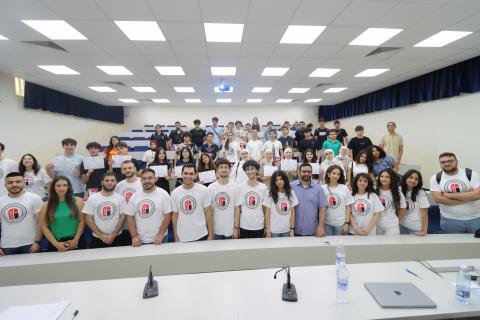
On May 31, 2025, the Computer Science Club (CSC) at Saint Joseph University of Beirut (USJ) transformed the Sciences and Technology Campus (CST) in Mar Roukoz into a dynamic arena of code, logic, and teamwork. The occasion? The first edition of The Computer Science Rally Paper, a first of its kind academic showdown built from the ground up to ignite curiosity and test the determination of Lebanon’s brightest high school minds.
The event kicked off at 10:00 AM with a warm welcome, coffee, team photos, and rising anticipation filling the atmosphere. Over 40 students from 15 schools across Lebanon, divided into teams of three, arrived, ready to tackle and conquer a gauntlet of 20 challenges strategically scattered around the campus.
So, how exactly was The Computer Science Rally Paper executed? Imagine a treasure hunt and a hackathon fused together. Teams raced to navigate physical checkpoints across the campus, uncovering clues and solving challenges that span the entire computer science spectrum: Artificial Intelligence (AI), cybersecurity, networking, programming, web development, algorithms, computer architecture, logical reasoning, and math. It's academic, but it's also a race where mental agility was paired with physical navigation.
Each challenge demanded sharp thinking, teamwork, and creative problem-solving. However, the students came prepared, driven not only by competition but by genuine curiosity and the will to learn.
Throughout the day, Campus-J documented the action, thanks to the coverage of reporter Lynn El Farran and photographer Sergio Chebly. The closing ceremony wrapped up the event at 5:00 PM, celebrating and honoring not just winners, but the collective ambition and spirit students showed.
The Winners
🥇 First Place: The Linked List, Collège Notre Dame des Soeurs Antonines Kfarchima
Michael Salloum (Captain), Youssef Chammas, Adam Salman
🥈 Second Place (Tie):
- - Three++, Collège des Frères Mont La Salle
Anthony El Khoury (Captain), Alphonse El Alam, Elio Eid - - M.A.D. Coders, Collège des Sœurs des Saints-Cœurs Sioufi
Marguerita Chaddad (Captain), Diane Saleh, Aya-Maria Shammas
🥉Third Place: The Debuggers, Al Bayader School Beirut
Hajar Daouk (Captain), Israa Kacim, Tala Saifi
The first-place team won a 25% scholarship to pursue a Bachelor of Science in Computer Science at USJ’s National Institute of Telecommunications and Informatics (INCI). A life-changing prize that reflects the university’s commitment to fostering home-grown talent.
The second- and third-place teams shared over $2,500 in prize money, representing a powerful investment in the next generation of problem-solvers.
The Computer Science Rally Paper was more than just a competition. It reshaped and redefined how young students experience computer science. The prizes weren’t just recognition; they were gateways and fuel to keep building and reaching new heights that seemed impossible before. It has set a new standard for computer science competitions in Lebanon.
What students gained on May 31 wasn't just a score; it was perspective. The Computer Science Rally Paper proved that learning can be a challenge, but with the right spark, it becomes a passion. And for the students who rose to that challenge, the future just got a little closer.
The success of this first edition and the momentum built on May 31 lit a fuse that’s already pushing plans forward. As the 2025–2026 academic year approaches, the CSC is thinking bigger, aiming higher, and building on everything this event proved possible. What started as a bold idea is now a movement. And this is only the beginning.
The Computer Science Rally Paper 2025: A New Era of Student Innovation
Facebook, Instagram, TikTok, X, LinkedIn… These are some of the most well-known social media platforms that you probably use every day. Maybe you use them to pass the time, promote a business, or simply because your friends pressured you into downloading the app so you could reply to the memes they send. Either way, social media has become a central part of your daily life.
Your social media presence is more than just a pastime; it has evolved into a crucial second identity that is deeply woven into your digital life. This second identity is vulnerable, it can be stolen, exploited, or weaponized against you.
As of February 2025, 5.24 billion individuals worldwide were social media users according to Statista. This number is large enough to make security breaches a real possibility, and you could fall victim to these breaches at any moment.
Even when you think your social media activity is harmless, it can whisper a surprising amount about you. Birthdays, addresses, pet names, and favorite sports teams are often shared without a second thought. Hackers sift through these breadcrumbs to answer security questions, guess passwords, and quietly map your life. When your timeline tells your story, who else is reading it?
Your routines and locations revealed through check-ins, geotagged photos, and frequent activity patterns, become invisible threads that can indicate where you live, work, and travel, making phishing attempts or physical targeting easier.
Your network is no longer just friends and colleagues. Follower/Following lists, groups, and tagged photos sketch a web of relationships that can be exploited for impersonation or manipulation. Even your opinions, likes, and comments leave footprints, constructing a portrait of your habits and preferences for anyone patient enough to watch.
The consequences are very real. Identity theft, fabricated accounts, and even the sale of personal information on the dark web are just the tip of the iceberg. The FBI estimates online impersonation attacks have cost victims over $5.3 billion. This is a silent epidemic fueled by digital footprints you didn’t even know existed.
Luckily, there are measures you can take to protect yourself. Always double-check any links sent to you. This is a simple yet effective measure against phishing links and websites. Additionally, use strong, unique passwords for each account, avoiding even slight variants. You can also track breaches using tools like Have I Been Pwned to see if your data has been compromised. Finally, privacy settings are your shields. Adjust them to limit who can see your posts, personal details, and friend list, and think carefully before sharing sensitive information like travel plans or daily routines.
Social media will continue to evolve, its features growing smarter, and its tracking subtler. Each new tool or AI-generated insight is another layer in the unseen map of your digital life. Remaining vigilant is necessary, and proactive security is more important than ever. Your second identity should remain under your control.
Your social media presence has objectively become a second identity. One that can be targeted, stolen, or exploited. Every photo you post, every status update, every “check-in” leaves a trail. To your friends, it’s just life updates. But to hackers, it’s a roadmap. Which begs the question: How much of yourself have you unknowingly handed over to strangers?