Anglais
L'Unité Assurance Qualité
Système de management
Évaluations
Planifications
Accréditations/Certifications
Recherche Institutionnelle
Planifications
Planification Stratégique
Le Plan stratégique traduit les objectifs stratégiques que l’Université veut atteindre pour réaliser sa vision en conformité avec sa mission et ses valeurs. Il identifie les axes stratégiques et établit les objectifs.
Un plan d’action institutionnel propose des actions/projets à mettre en œuvre pour atteindre les objectifs, ainsi que les ressources humaines, financières et les infrastructures nécessaires.
La Politique de planification institutionnelle décrit la démarche à suivre, précise les rôles et les responsabilités des différents acteurs, et définit le processus de suivi annuel de l’implémentation et de la mise à jour de ce Plan stratégique et du Plan d’action quand cela est jugé nécessaire.
- Élaboration du Plan stratégique
- Le processus est lancé par le Recteur un an avant l’échéance prévue pour le Plan stratégique actuel. Il peut également être initié par une demande du Conseil restreint (CR), du Conseil de l’Université (CU) ou du Haut conseil (HC).
- Le Comité de pilotage stratégique (CPS) assure le pilotage du processus de planification stratégique.
- Le processus débute par une analyse de la situation (analyse SWOT) effectuée par les commissions permanentes pour identifier les points forts, les points faibles, les opportunités et les risques que l’Université risque d’affronter. Cette analyse tient compte des avis des parties prenantes internes et externes de l’Université : Conseil stratégique, Doyens, Directeurs, Enseignants, Personnel, Étudiants, Alumni, Employeurs, etc.
- Suite à cette analyse, une révision de la Vision, de la Mission et des Valeurs est effectuée par le Comité de pilotage stratégique en impliquant les parties prenantes de l’Université. Le Comité décide de la durée visée (5 à 7 ans). Il identifie les axes prioritaires et leurs buts (« Strategic Goals ») et forme des commissions responsables de l’élaboration du Plan stratégique (CEPS) ; Une commission pour chaque axe. Celles-ci incluent des membres des parties prenantes internes et externes de l’Université.
- Les CEPS proposent les objectifs stratégiques et les initiatives y relatives. Elles préparent un plan d’action et fixent les indicateurs de performance ainsi que le seuil de performance à atteindre. Un Guide de planification stratégique est mis à disposition des parties prenantes de l’Université.
- L’UAQ, en collaboration avec le Secrétaire général, participe à la rédaction de la version finale du Plan stratégique.
- Le Conseil restreint se prononce sur le Plan stratégique proposé.
- Le Conseil de l’Université discute le Plan stratégique soumis par le Conseil restreint puis le valide.
- Le Haut Conseil émet un avis sur les questions stratégiques puis valide le Plan stratégique proposé.
- Le Secrétaire général, en collaboration avec le Service des publications et de la communication (SPCOM), communique le Plan stratégique à toutes les parties prenantes internes et externes par le biais de multiples canaux (site web, e-mail, réunions, etc.).
- Au niveau des institutions (facultés et instituts), le Conseil de chacune élabore un plan d’action spécifique aligné avec les objectifs stratégiques de l’Université. Il tient compte de l’avis de son Conseil d’orientation stratégique, organe consultatif qui regroupe des parties prenantes de l’institution dont des représentants du marché du travail.
- Les services et entités rattachés au Recteur ou aux Vice-recteurs élaborent leurs plans d’action avec l’aval du Recteur ou le Vice-recteur concerné.
b. Implémentation et suivi
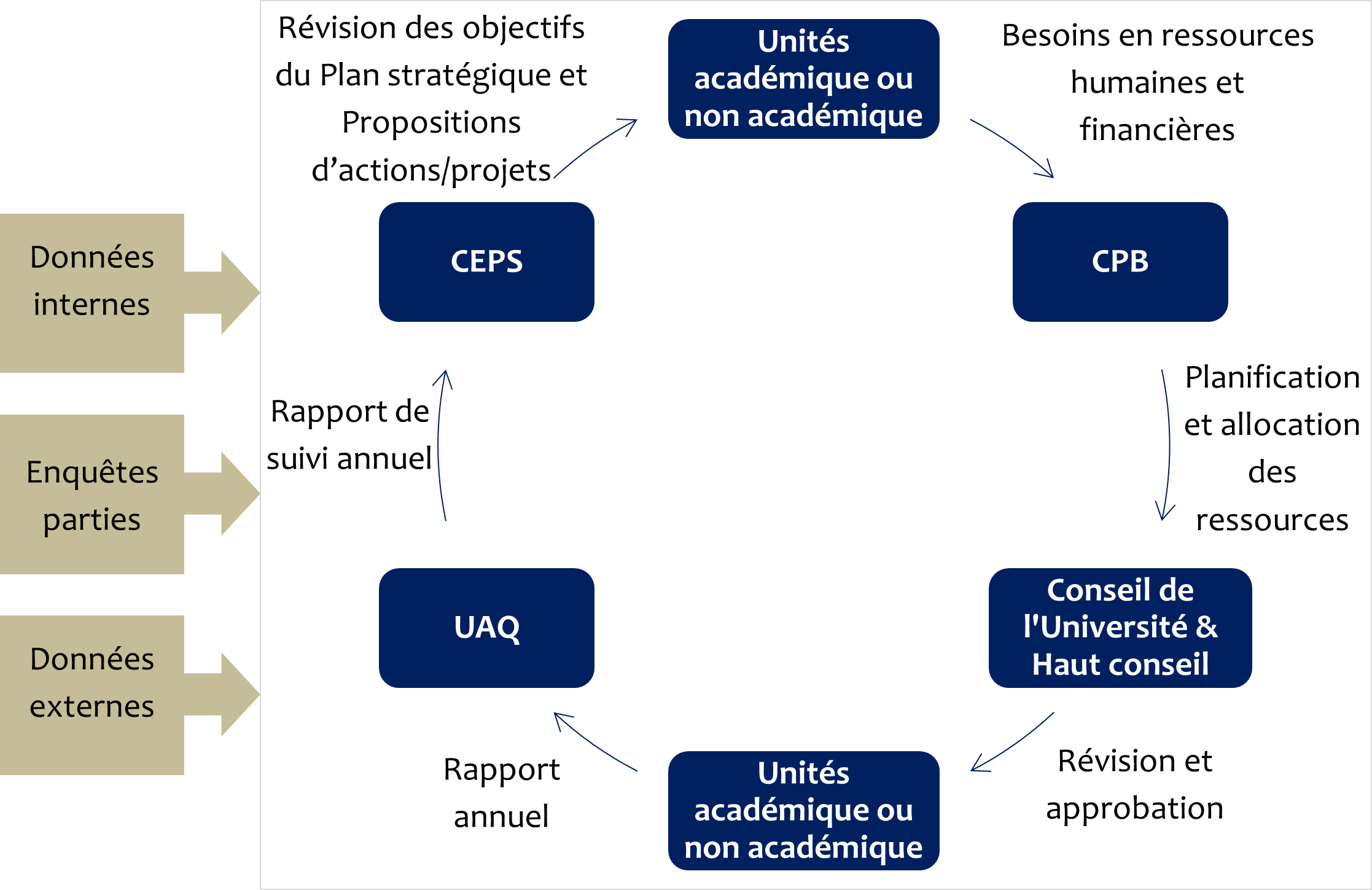
Pour assurer le suivi de l’implémentation du Plan stratégique, chaque unité académique ou non académique prépare un rapport annuel en juillet pour montrer sa contribution à la réalisation du Plan stratégique de l’Université et pour proposer un plan d’action à court terme aligné avec ce Plan stratégique.
L’UAQ soutient cette opération en préparant, entre novembre et janvier, un rapport de suivi annuel. Ce rapport de suivi et les rap ports annuels des entités académiques et non académiques sont mis à la disposition du Recteur et des CEPS responsables du suivi de l’implémentation du Plan stratégique.
Les CEPS proposent les actions/projets stratégiques à implémenter et revoient les objectifs du Plan stratégique si nécessaire.