
 French
USJ Inaugurates the Chair Pierre Gannagé on Legal and Cultural Pluralism
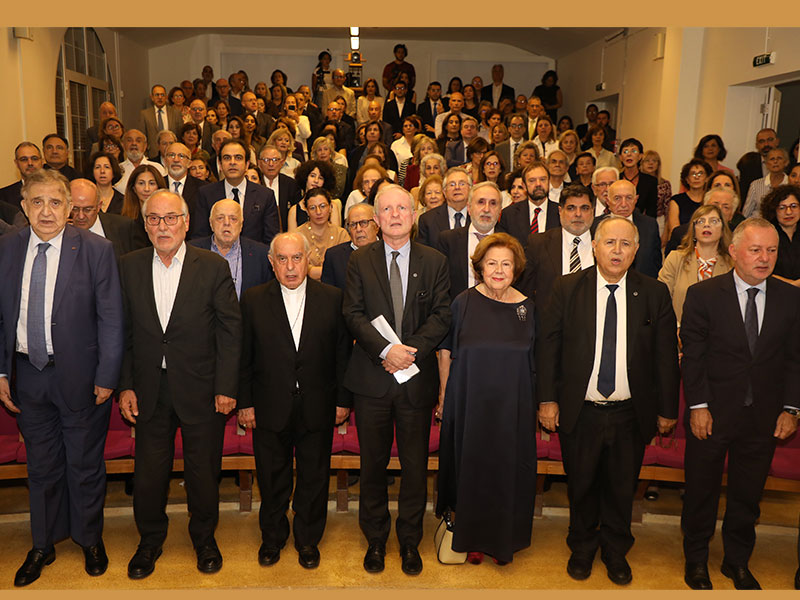
Beirut, October 2026 – The Faculty of Law and Political Science (FDSP) at Saint Joseph University of Beirut (USJ) officially inaugurated the Chair Pierre Gannagé on Legal and Cultural Pluralism at the University’s historic Bibliothèque Orientale (Oriental Library, BO). The ceremony welcomed alumni, colleagues, academics, and prominent figures in law and politics.
In his address, Prof. François Boëdec, SJ, Rector of USJ, paid tribute to Prof. Pierre Gannagé, highlighting his invaluable contributions to the University and FDSP, his influence on legal thought, and the human qualities and moral values that have earned him the gratitude of Lebanon as a whole. He described the inauguration of the Chair as a celebration of a scholar whose work and ideas have left a profound and lasting mark on Lebanon and resonated far beyond its borders. Established to honor and preserve the intellectual legacy of former Dean Pierre Gannagé, the Chair will also carry his ideas forward through research, symposia, and conferences.
Opening the ceremony, Dean Najm reflected on Prof. Gannagé’s exceptional contribution to legal education and scholarship. More than a distinguished professor, Prof. Gannagé helped students understand the deeper meaning of law, approaching it with intellectual rigor, clarity, and an unwavering commitment to its purpose. His scholarship was particularly influential in Lebanese private international law relating to family matters, where he brought order to a complex body of legislation and judicial decisions, identified underlying principles, and established a coherent framework for legal analysis.
A leading scholar of legal and cultural pluralism, Prof. Gannagé devoted much of his research to the legal systems of societies divided along religious and communal lines. Dean Najm stressed the urgency of carrying that work forward, particularly as Lebanon continues to grapple with deep divisions over identity and belonging. Prof. Léna Gannagé explained why establishing the Chair has become especially important. At a time when Lebanon’s model of pluralism is under growing strain, its legitimacy increasingly questioned, and a growing weariness with diversity taking hold, revisiting Prof. Gannagé’s ideas is more relevant than ever. The Chair will build on his research into the legal systems of multicommunal societies, with particular attention to Lebanon. His work, as Prof. Boëdec emphasized, challenged the assumption that diversity inevitably leads to disorder. It showed that different communities and legal traditions can coexist within a framework of equity and the rule of law. Continuing that legacy means advancing two principles central to Prof. Gannagé’s scholarship: upholding the secular character of the State without compromising the identities of its communities, and reconciling religious legal systems with the requirements of secular law.
Gannagé’s Legacy in Focus
The event continued with two panel discussions examining Prof. Gannagé’s intellectual legacy and the contemporary challenges of pluralism.
The first, Pierre Gannagé: A Jurist and a Humanist, featured Honorary Dean Fayez Hage-Chahine and Charles Jarrosson, Professor Emeritus at Paris-Panthéon-Assas University.
Prof. Jarrosson highlighted the international reach of Prof. Gannagé’s legal scholarship, while Dean Hage-Chahine emphasized the significance of establishing a Chair in his honor. He praised Prof. Gannagé’s writings for their precision, restraint, wisdom, relevance, and critical examination of legislation and judicial decisions. Through this rigorous approach, Prof. Gannagé helped establish legal pluralism as a field of study with a solid theoretical and technical foundation. Dean Hage-Chahine also suggested adding “equity” to the Chair’s name to better reflect the human and ethical values that informed Prof. Gannagé’s approach to law.
The second panel, moderated by Charles Jarrosson, addressed a question with particular relevance to Lebanon: “Can a Pluralist Society Form a Nation?” Joseph Maïla, Professor of International Relations at ESSEC Business School and former Rector of the Catholic University of Paris, opened the discussion by examining the indispensable role of the State in sustaining pluralism. “Diversity without a State has a name: chaos. It is the State that gives meaning to diversity,” he stated. For Maïla, pluralism depends on the constitutional recognition and institutional regulation of diversity. Reflecting on Lebanon’s experience, he also addressed the lasting effects of collective trauma and the existential fears rooted in historical massacres. Examining different understandings of nationhood, he stressed that solidarity is essential to building a shared sense of belonging that transcends communal affiliations.
Roula El Husseini Begdache and Youmna Makhlouf then turned to the legal and institutional realities of Lebanon. Through an examination of conflicts of laws, they highlighted the tensions individuals face between their civil identity and mandatory affiliation with a religious community. Makhlouf also challenged the recurring tendency to question the viability of the Lebanese State solely through the lens of pluralism. She suggested that this debate risks diverting attention from equally important socioeconomic factors that determine the country’s future.
The inauguration and discussions reaffirmed the purpose of the Pierre Gannagé Chair: to keep his intellectual legacy alive while advancing the debate on the future of legal and cultural pluralism in Lebanon. For Prof. Boëdec, that legacy extends far beyond academia. By passing Prof. Gannagé’s knowledge and ideas on to future generations of jurists, USJ will ensure that his remarkable scholarship and profound humility continue to inspire its students and graduates, while helping preserve the foundations of Lebanon itself.
Also read: Inauguration de la Chaire Pierre Gannagé sur le pluralisme juridique et culturel à l’USJ