
 French
 Arabic
Closing Ceremony of the Code for Lebanon Initiative
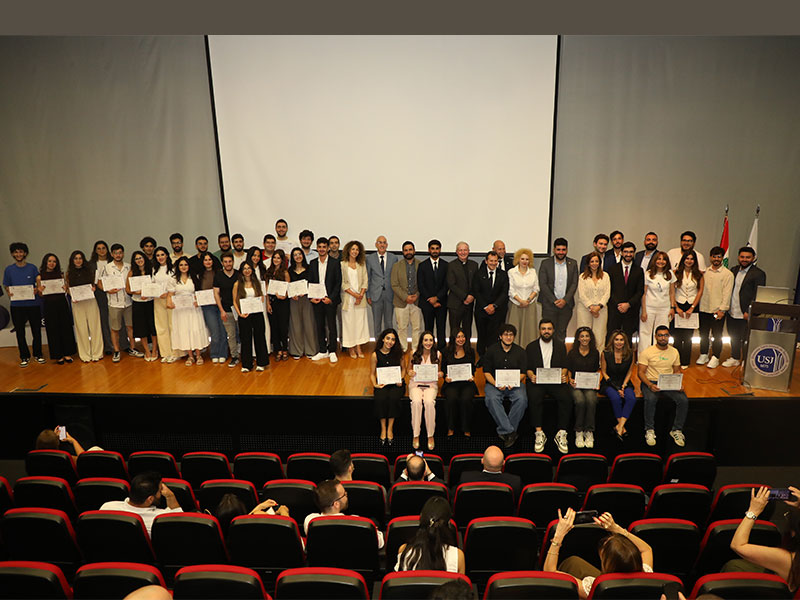
Saint Joseph University of Beirut (USJ) organized the closing ceremony of the Code for Lebanon initiative on Friday, July 3, 2026, marking the conclusion of a project carried out in partnership with the Ministry of Technology and Artificial Intelligence (MITAI) and HTech. Held at the François S. Bassil Auditorium at the Innovation and Sports Campus, the event took place in the presence of His Excellency Mr. Kamal Shehadi, Minister for the Displaced and Minister of State for Technology and Artificial Intelligence, Prof. François Boëdec, SJ, Rector of USJ, Mr. Hussein El Hajj, CEO of HTech, as well as several university officials, partners, faculty members, students, and parents.
A few months after the Code for Lebanon Hackathon, organized at USJ last February, this ceremony marked the conclusion of an innovation journey led by the students. Accompanied by the HTech and MITAI teams, the winning team transformed its prototype into a fully developed dashboard designed to support the national NUMŪ program, illustrating the role that universities can play in Lebanon’s digital transformation.
Opening the ceremony, Prof. Wassim Raphael, Dean of the Faculty of Engineering and Architecture, recalled that this initiative goes far beyond the framework of a technology competition. “We are not simply celebrating the results of a hackathon. We are celebrating curiosity, creativity, and teamwork,” he said. Stressing that “technology has little value if it does not improve people’s lives,” he emphasized USJ’s mission to train “leaders with integrity” and “citizens who understand that innovation comes with responsibility.” Before concluding, he addressed a message to all participants: “Every student who took on this challenge is a winner.”
Prof. François Boëdec, SJ, Rector of USJ, praised a project that demonstrates young people’s ability to become changemakers. “You are not waiting for change, you are building it,” he said, highlighting a model of cooperation bringing together the State, the private sector, the University, and youth. Recalling the University’s mission, he stressed that “the Code for Lebanon project is fully aligned with this mission: linking academic excellence to a direct ethical commitment within the very structure of the country,” before expressing his hope that this dynamic would extend to more disciplines and projects of public interest.
Taking the floor, His Excellency Minister Kamal Shehadi praised USJ’s commitment to this initiative and recalled that Code for Lebanon opens a new path for public innovation. “Students are not only the beneficiaries of digital transformation, they are its actors and builders,” he said. Presenting the NUMŪ dashboard, he explained that it will make it possible to measure the impact of the actions undertaken, strengthen collaboration between the various partners, and support public policies, recalling that “what is measured can be managed, and what is managed can be transformed.” Finally, he congratulated all the participants, convinced that Lebanon has all the talent needed to meet the challenges of tomorrow.
Ms. Nour Fayad, Senior Project Manager and Talent Track Lead at MITAI, presented the ambitions of the NUMŪ program, which aims to develop digital and artificial intelligence skills at the national level. “Our greatest asset in Lebanon is our talent,” she recalled, before adding that “NUMŪ was born from a simple conviction: to give every Lebanese citizen the opportunity to become an engaged actor in digital transformation.” She also described the dashboard developed by USJ students as a “real strategic tool,” designed to support decision-making and the development of public policies.
In his speech, Mr. Hussein El Hajj, CEO of HTech and INCI alumnus, looked back on the birth of Code for Lebanon, an initiative born from the desire to bring students closer to the concrete challenges of the public sector. He recalled that the project is guided by a strong conviction: “Lebanese youth do not need to wait to make an impact.” Referring to the NUMŪ dashboard, the result of several months of collaboration between the students, HTech, and the Ministry, he praised an achievement that demonstrates that university innovation “can play a direct role in the transformation of the country,” while expressing his hope that this dynamic would extend to other universities and institutions.
The ceremony continued with the presentation of the NUMŪ dashboard by Mira Dalati and Laeticia Mallat, members of the hackathon’s winning team. They presented the result of the work carried out over the past few months with the support of the HTech and MITAI teams, illustrating the transition from an idea born within the framework of a competition to a concrete solution serving a national initiative.
The members of the winning team were then presented with their certificates in recognition of their commitment, creativity, and the quality of the work accomplished. The ceremony concluded with an exchange between His Excellency Minister Kamal Shehadi and the students, followed by a group photo bringing together all the participants, symbolizing a successful collaboration between the University, public authorities, and the private sector in the service of innovation and Lebanon’s future.
Read also: اختتام مبادرة كود فور ليبانون
Click here for more photos
Speech of Prof. François Boëdec, SJ, Rector of USJ
Also read:
Clôture de l’initiative Code for Lebanon : L’USJ célèbre une jeunesse au service de l’innovation publique
اختتام مبادرة كود فور ليبانون