 French
USJ Hosts the 3rd C2R Middle East General Conference
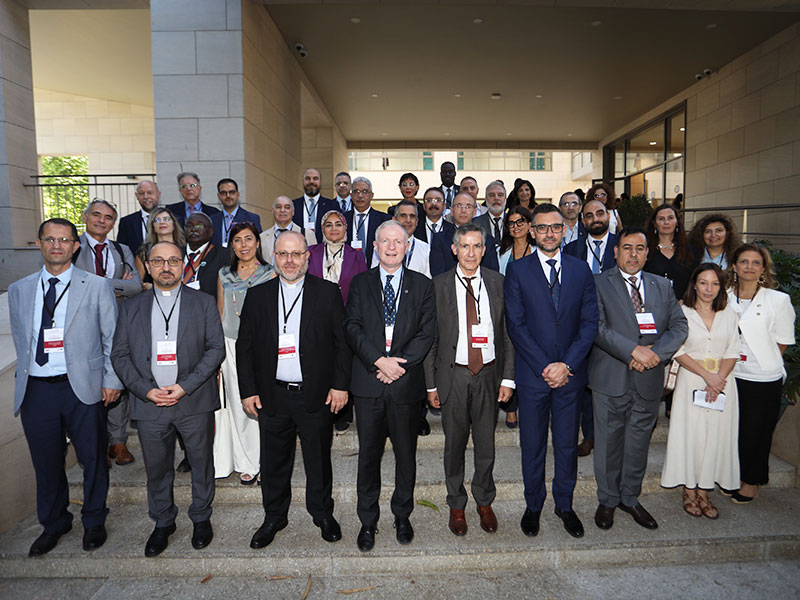
Artificial intelligence, climate change, health, peace and mediation are reshaping the role of universities. These challenges brought higher education leaders from across the region to Saint Joseph University of Beirut (USJ) on 17 and 18 September 2026 for the 3rd C2R Middle East General Conference, organized with the Agence Universitaire de la Francophonie (AUF) Middle East. The two-day meeting provided an opportunity to share experience and strengthen cooperation among universities across the region.
C2R Middle East brings together AUF member institutions to address strategic issues facing higher education, exchange ideas and develop solutions. Its thematic committees take this work forward through a series of joint initiatives.
Universities Called to Understand, Act, and Connect
The conference opened on September 17 at USJ’s Innovation and Sports Campus under the patronage of H.E. Rima Karami, Lebanon’s Minister of Education and Higher Education. Leading the opening session were Prof. François Boëdec, SJ, Rector of USJ and outgoing President of C2R Middle East; Dr. Jean-Noël Baléo, Regional Director of AUF Middle East; and Fr. Joseph Moukarzel, Rector of Holy Spirit University of Kaslik and newly elected President of C2R Middle East. The event brought together rectors, university presidents and academic leaders from AUF member institutions across 13 countries in the region.
Addressing representatives of C2R’s 53 member institutions, Prof. Boëdec spoke of the uncertainty and rapid change facing the Middle East and the responsibility of universities to prepare young people not only for the job market, but also “to embrace their humanity.” With the world needing “engaged and responsible citizens more than ever,” he stressed the role of universities in building peace and responding to the region’s climate and environmental challenges. He described C2R as “a particularly relevant framework” for giving Middle Eastern universities a stronger voice and congratulated Fr. Moukarzel on his election as President.
Dr. Baléo called C2R “a space for dialogue, cooperation, and debate,” with representatives from 11 countries gathering in Beirut. As repeated crises push university leaders toward short-term priorities, he argued that their core mission demands a longer view: “to create knowledge and expertise and to educate the next generation.” The conference offered a rare opportunity to step away from immediate pressures, challenge ideas and share solutions. Dr. Baléo also credited USJ’s Vice-Rectorate for International Relations for its role in organizing the event, particularly recognizing Vice-Rector Carla Eddé’s contribution.
Fr. Moukarzel outlined a vision built on three principles: “understand, act and connect.” At its core was a question increasingly facing higher education: “What is the responsibility of a university today in the face of a changing world?” On AI, Fr. Moukarzel argued that the challenge is to harness its potential without allowing it to “diminish our humanity.” He also pointed to the role of universities in a divided region as places where opposing views can meet without turning disagreement into conflict. “When political bridges become fragile, academic bridges must remain open,” he said.
The opening session also recognized key figures for their contributions to higher education and regional cooperation. USJ awarded its University Medal to H.E. Rima Karami, represented by Prof. Mazen El Khatib, Director General of Higher Education. El Khatib also received USJ’s Heritage book, marking the University’s longstanding partnership with the Ministry. Dr. Baléo and Fr. Moukarzel received USJ’s 150th Anniversary Medal, while AUF honored Prof. Salim Daccache, SJ, and Prof. Boëdec for their longstanding support of AUF, C2R Middle East and the Francophonie.
Joining remotely, AUF Rector Prof. Slim Khalbous presented the Agency’s 2026–2029 strategy, which updates its five existing priorities to reflect shifts in higher education. Key areas include generative AI and the digital transformation of research, youth civic engagement, scientific diplomacy, educational innovation and greater recognition of research, with a stronger focus on connecting universities with the socioeconomic sector. The strategy pairs a shared global vision for the scientific Francophonie with an approach tailored to the needs, realities and stages of development of each region.
Two Days of Ideas and Exchange
The first day featured two expert panels on some of the most pressing issues facing higher education. The first, “Artificial Intelligence: How Can I Prepare My University?”, moderated by Dr. Baléo, examined the impact of AI on higher education and how universities are responding. Panelists included Nada Moghaizel Nasr, Honorary Dean and Rector’s Delegate at USJ, and President of the Lebanese National Commission for UNESCO. The second panel, “Climate Change, Health, and Society: Toward a Sustainable and Unified Approach to Research,” explored the links between scientific, environmental, health and societal challenges. It was moderated by Prof. Richard Maroun, USJ Vice-Rector for Academic Affairs and Head of C2R Middle East’s Research Committee. Between sessions, participants visited the Ralph Audi Simulation Center at USJ’s Faculty of Medicine.
The second day opened with a review of C2R Middle East’s four thematic committees, covering research, internationalization, quality assurance and accreditation, and mediation and conflict management, moderated by Prof. Boëdec. The final panel, “Peace and Mediation in the Middle East: What Role for Universities?”, turned to the role of higher education in promoting dialogue and building peace. The session was moderated by Johanna Hawari Bourjeily, Director of USJ’s Professional Mediation Center.
The two-day event closed with a private General Conference focused on membership, the renewal of thematic committees, the appointment of Vice-Presidents and preparations for the next meeting. Fr. Moukarzel delivered the closing remarks.
Building Networks, Driving Change
Over two days in Beirut, universities from across the Middle East shared challenges, ideas and experience at a time when many of the forces reshaping higher education extend well beyond national and disciplinary boundaries. From artificial intelligence and research to climate change and peace, the message was clear: universities cannot respond in isolation. C2R Middle East provides a platform for that cooperation, connecting institutions, sharing knowledge and strengthening their collective ability to respond to change and serve the societies around them.