 French
From Understanding to Developing AI: ETIB Launches a Pioneering University Diploma for Language Professionals
As artificial intelligence transforms the language professions, ETIB is determined to do more than adapt to change. Rather than resist the technology or simply follow its advances, it is taking a proactive approach: understanding how AI works, questioning its implications, and contributing to its development.
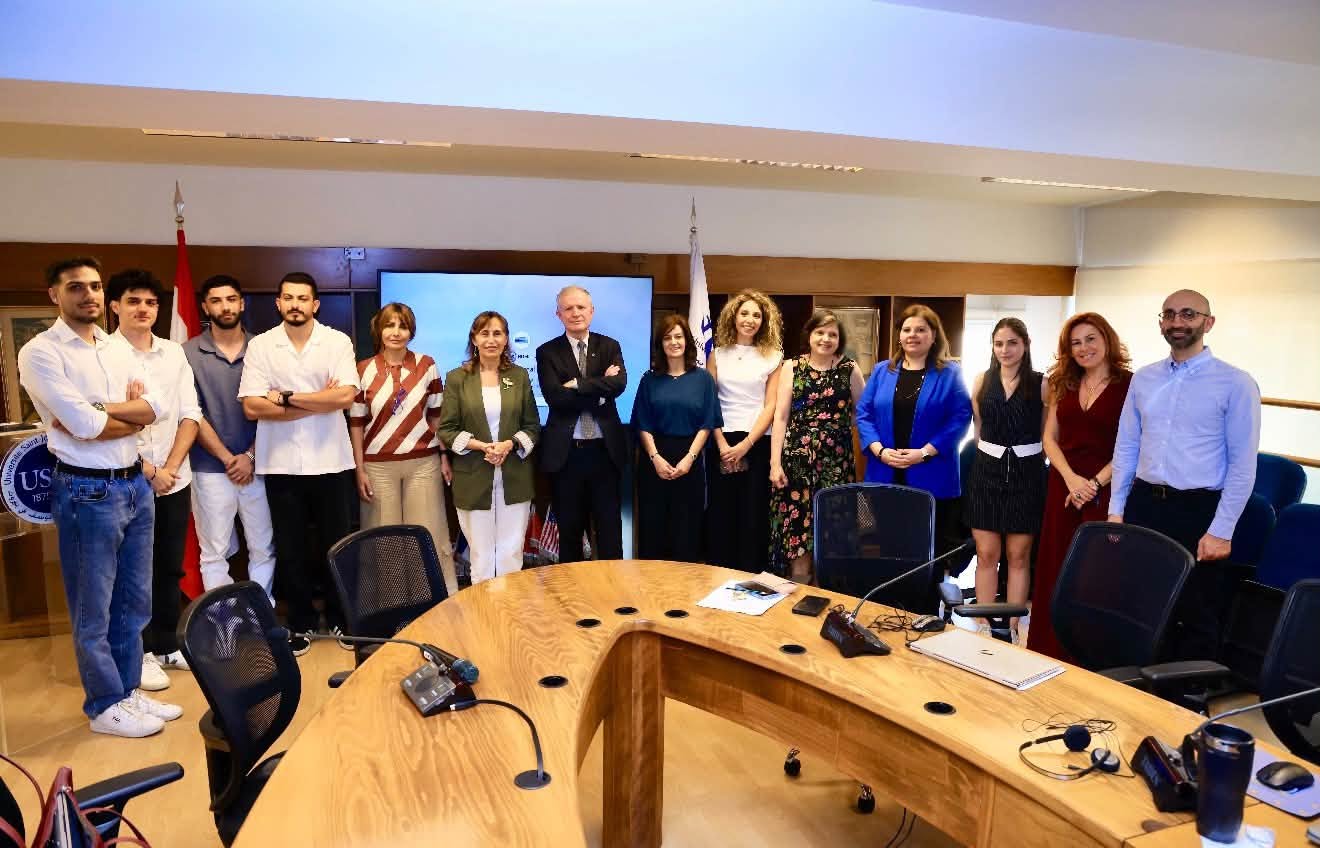
To mark International Translation Day, the School of Translators and Interpreters of Beirut (ETIB) at Saint Joseph University of Beirut (USJ) hosted a roundtable in collaboration with the School of Engineering of Beirut (ESIB), CINIA-USJ and the Faculty of Science to launch its University Diploma in Language Engineering Applied to Language Professions. The new program reflects ETIB’s commitment to anticipating the profound changes transforming translation, interpretation and multilingual communication. The first of its kind in Lebanon, the six-month diploma is offered entirely online, with English as the language of instruction and Arabic as the working language. It equips language professionals with the skills to harness AI technologies while drawing on the human expertise essential to their fields.
The hybrid roundtable, titled “Co-Constructing AI for Language Professions: From Collaborative Innovation to the Training of Tomorrow,” brought together Prof. François Boëdec, SJ, Rector of USJ, academic leaders and instructors, ETIB students and representatives of partner institutions from around the world. The discussion focused on the role of interdisciplinary collaboration in shaping the future of language professions, particularly in equipping professionals to understand emerging technologies, assess their capabilities and limitations, work alongside technical experts and integrate these tools effectively into their professional practice.
Prof. Gina Abou Fadel Saad, Dean of the Faculty of Languages and Translation, emphasized that ETIB’s pioneering spirit, dating back to its founding in 1980, has always meant embracing change and preparing for the future. Her approach to AI was clear: “We do not intend to let artificial intelligence determine our future, nor do we seek to fear it or embrace it blindly. We want to understand it, critically assess its capabilities, and, when appropriate, develop AI technologies ourselves.”
Prof. Mary Yazbeck, Director of ETIB, discussed the rise of AI and the growing debate over whether it could eventually replace language professionals. ETIB responded to these far-reaching changes by launching its UD, designed to equip future language professionals with the skills they will need. As Prof. Yazbeck explained, the program follows a structured progression: “First, understand natural language processing and machine translation; then learn to develop the data that power these systems; master prompt engineering, along with the integration and, above all, evaluation of large language models to enhance human capabilities; explore the foundations of knowledge engineering; develop the critical judgment essential to addressing ethical questions, critically examining technology and exercising professional responsibility; and finally, apply these skills through a supervised project.” Prof. Yazbeck explained the program’s philosophy through four principles: “Understand before using, develop before adopting, evaluate before trusting, and maintain human responsibility at every stage.”
Prof. Ziad Francis of the Faculty of Science highlighted the longstanding connection between translation and AI, emphasizing the importance of involving language professionals from the earliest stages of AI tool design and development.
Prof. Michela Bertozzi of the University of Bologna presented a self-directed training platform specifically adapted for students in ETIB’s Master in Interpretation program. The platform combines structured exercises, peer learning and digital tools, allowing students to develop their interpreting skills at their own pace through a clearly defined learning sequence.
The second half of the roundtable highlighted the expanding role of language professionals as key partners in AI development, working alongside technical experts to identify needs, define requirements, test prototypes, evaluate results and help improve the tools designed for their professions.
ETIB’s new Master in Interpretation program places greater emphasis on technology and research and includes ETIB Interpreter Trainer, a platform designed to help students practice independently. Prof. Lina Sader Feghali, Head of the Department of Interpretation, who initiated the project, outlined its three objectives: “To strengthen education by developing students’ technological skills; advance research by creating an incubator for projects that turn technical challenges, particularly in Arabic language processing, into research questions; and foster innovation by providing a space for technological experimentation and interdisciplinary collaboration to support students’ independent practice.”
What began as an idea on paper grew into a collaborative project involving three USJ institutions. ETIB contributed its expertise in interpreting, the Center for Digital Innovation and Artificial Intelligence (CINIA), led by its Director, Wadad Wazen Gergy, connected professional needs with technological possibilities, and ESIB brought its expertise in artificial intelligence. For Gergy, the platform is “a perfect example of USJ’s vision for digital transformation, one that brings together instructors, students, administrative departments and experts, supported by good governance.”
Prof. Chantal Saad Hajjar, Head of ESIB’s Department of Computer and Communications Engineering, underscored the project’s educational value for future engineers, who learned to look beyond the technical aspects, understand users’ needs and refine their solutions accordingly. She also credited its success to the “excellent collaboration between ESIB, CINIA and ETIB.”
Joe Haddad, Marc Khattar, Kevin Khoury and Ali Ali, engineers from the inaugural cohort of ESIB’s recently introduced artificial intelligence concentration, presented the platform’s key features and discussed the challenges of developing it, particularly in processing Arabic.
Wissam Antoun, a PhD candidate at ALMAnaCH/Inria Paris, further highlighted the challenges of Arabic language processing, particularly the tendency of AI systems to automatically “correct” errors made by Arabic-speaking learners rather than accurately identify them.
The discussion concluded with feedback from the platform’s users. Grace Abou Khaled, a conference interpreter and ETIB instructor, stressed that the platform supports students’ learning without replacing their instructors. “AI feedback is not an absolute truth,” she explained. “We are not seeking to reduce training, but to improve how we train by developing tools with the people who use them.”
Christia Slim, a student in the Department of Interpretation, highlighted how the platform helps her put classroom learning into practice while giving her greater independence and easier access to training.
Through its UD, ETIB aims to prepare the next generation of language experts not only to work with emerging technologies, but also to contribute to developing solutions tailored to the needs of their professions.
Prof. Mary Yazbeck left the audience with a challenge: “The best response to those who predict the disappearance of our professions may not be to prove them wrong, but to make sure they never turn out to be right.”