
 French
Professor Roland Tomb Elevated to the Rank of Chevalier de la Légion d'honneur
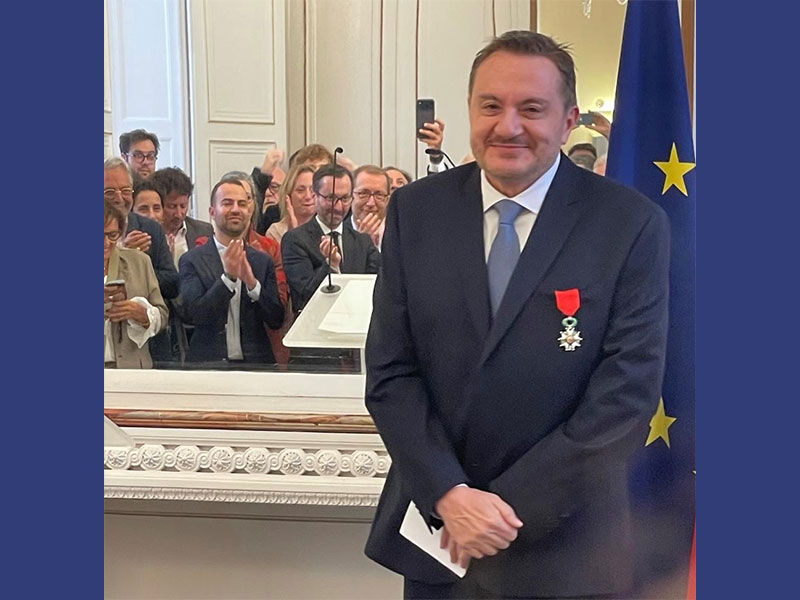
Prof. Roland Tomb, Director of the University for All (UPT) at Saint Joseph University of Beirut (USJ), Honorary Dean of the USJ Faculty of Medicine and guest professor at the Collège de France, was raised to the rank of Chevalier de la Légion d'honneur during a ceremony held on June 9, 2026 at the French Ministry of Higher Education and Research in Paris.
The medal was awarded to him by Minister Philippe Baptiste, in the presence of Prof. François Boëdec, SJ, Rector of USJ, the Lebanese Minister of Foreign Affairs, H.E. Mr. Joe Rajji, as well as many personalities from Lebanon, France and several other countries.
At the beginning of his speech, Mr. Philippe Baptiste was delighted to welcome Prof. Tomb within the ministry, highlighting the symbolic significance of the place chosen for this ceremony. Other institutions could have legitimately welcomed such a tribute, he observed, referring to the Ministry of Health, the Ministry of Foreign Affairs or the Collège de France. But the choice of the ministry in charge of higher education and research had a special significance, as it referred to the two main threads of a life dedicated to “the search for truth and its transmission.”
The Minister recalled that Prof. Tomb’s career goes far beyond the usual borders of academic disciplines. A recognized doctor, respected academic and intellectual curious about everything, he has always cultivated an appetite for knowledge that led him to multiple directions, with an equal concern for excellence.
This distinction also honored a man deeply attached to France. “You have always been not only a francophone, but also a passionate Francophile,” said the Minister, seeing in this attachment not only the legacy of a family history, but also that of a secular relationship between Lebanon and France. Referring to the famous words of General de Gaulle on the ties uniting the two peoples, Baptiste stressed how much Roland Tomb embodied this reciprocal fidelity which crosses generations.
Then, he drew the portrait of an academic whose intellectual curiosity evokes that of the humanists of the Renaissance. “In you, France honors a humanist,” he said, praising a doctor who is able to combine scientific rigor with constant reflection on culture, history and the very foundations of knowledge.
Medical students were among the first witnesses to this singular approach. Philippe Baptiste recalled with admiration some initiatives that marked his deanship, notably the introduction of general knowledge tests in the admission exams for medical studies, as well as the unexpected opening of a course devoted to the Phoenician language. A way of asserting that the training of a doctor should not be limited to the acquisition of technical skills, but must be part of a broader understanding of the human being and his civilization.
This vision now finds a natural extension in UPT, of which Roland Tomb is the Director. At the head of this institution open to all generations, he is free to indulge his passion for transmitting knowledge and to introduce a wide range of students to the richness of disciplines as varied as literature, history, sciences, and ancient languages.
The French Minister also painted a more personal portrait of the man behind the academic. Those who have visited his office are familiar with his fondness for Franco-Belgian comics and the many Tintin figurines that occupy a special place there. This enduring attachment to Hergé’s world reflects an appreciation for the “clear line” style, mirroring the intellectual rigor that has always guided his thinking.
With humor, Philippe Baptiste spoke of the thirst for knowledge that has never left him. His travel companions know that he often departs and returns with suitcases filled with books, while others plan to bring back souvenirs. An anecdote that reflects a life shaped by reading, curiosity, and a constant spirit of discovery.
The Minister also recalled the many facets of an exceptional career. A renowned dermatologist, Roland Tomb built the reputation of his department at Hôtel-Dieu de France and contributed to enhancing the standing of USJ’s Faculty of Medicine. A prolific researcher and author of numerous scientific publications, he has also played a significant role within French and Lebanese societies in the field of dermatology.
His leadership was recognized by his peers through a rare distinction: his election on three occasions as Dean of the Faculty of Medicine. Under his leadership, USJ equipped itself with innovative tools, notably a state-of-the-art simulation center, while continuing to develop medical training in line with the highest international standards.
Philippe Baptiste also highlighted qualities that are less visible yet equally essential: his constant attention to hospital and university teams, his commitment to institutional continuity, and his determination, after twelve years at the head of the Faculty, to prepare for his succession in order to ensure the long-term sustainability of the initiatives he had undertaken.
Finally, he emphasized how Professor Tomb’s passion for ancient languages, such as Syriac, Phoenician, and Hebrew, reveals a deeper intellectual quest: a desire to return to the sources in order to transcend the divisions that separate peoples, religions, and nations. Born in a land often marked by the fractures of history, he has consistently sought to build bridges between cultures and heritages.
For more than forty years, Philippe Baptiste concluded, Roland Tomb has devoted his life to research and the transmission of knowledge. By breaking down disciplinary boundaries, bringing medicine and the humanities closer together, and fostering a love of the French language in both Lebanon and France, he fully embodies the ‘new humanism’ that our times so desperately need.
Professor Tomb’s emotion was palpable as he took the floor to thank the French Republic for this distinction, which he received with heartfelt gratitude. From the outset, he placed his intervention under the sign of friendship, a value that has accompanied him throughout his personal and professional journey. “I am beginning to believe that friends are those who know us so well that they eventually come to think us better than we are and who, out of affection, help us believe it a little more ourselves,” he confided to an audience that included guests from fourteen different countries.
Far from viewing this as a symbol of a globalized elite, he preferred to see it as “something far rarer: a gathering of true friends,” reminding those present that human relationships are often the greatest reward of a life devoted to the service of others. The presence of the Lebanese Minister of Foreign Affairs, H.E. Mr. Joe Rajji, a longtime friend, gave him the opportunity to share a conviction close to his heart: “Friendship is received as a gift of life and preserved through the daily choice of fidelity.”
Throughout his speech, the institutions that have shaped his life naturally found their place in his narrative. His gratitude toward the Collège de France was accompanied by a heartfelt tribute to Saint Joseph University of Beirut, of which he has become, over the decades, one of its most distinguished figures. Reflecting with humor on his arrival at USJ thirty-three years ago, at a time when he was not a graduate of the institution, he recalled that “at first, people spoke of a parachute appointment,” before noting that “we very quickly grew accustomed to one another.” The shared history that followed led his colleagues to place their trust in him on three occasions by electing him Dean of the Faculty of Medicine, to the point that “our paths became inseparable.”
The presence of Prof. François Boëdec, SJ, who had traveled especially from Beirut to attend the ceremony, was particularly moving for him. Through him, he wished to pay tribute to the institution as a whole, extending his best wishes for success to the man who recently took over as head of the University in a particularly challenging context. Convinced that the new Rector will, “as a true Breton, steer the ship safely to harbor despite the turbulence and the storms,” he reaffirmed his confidence in the mission pursued by USJ “in the service of society, Lebanon, and the Francophonie.”
This plea in favor of the Francophonie was one of the highlights of his intervention. Heir to a long tradition of dialogue between Lebanon and France, Professor Tomb recalled the extent to which the French language remains an integral part of Lebanon’s cultural identity, while warning of the threats it faces today. “The status of the French language is under threat in Lebanon as it has never been before,” he observed gravely, arguing that defending this language and the culture it conveys now requires more than a mere statement of principle.
A longtime advocate of the Francophonie, he called for a stronger commitment from France in this region of the world. Quoting Albert Camus, for whom “My homeland is the French language,” he recalled that Francophones maintain a bond with France that extends far beyond national borders. As a French-Lebanese man himself, he wished to bear witness to the particular affection that many Lebanese feel for France: “You have no idea how deeply some Lebanese cherish France,” an attachment rooted in their love of the French language.
This reflection gave rise to one of the most inspired moments of his speech. Language, he explained, “is not merely a tool for communication.” It is also “a way of being, a particular light cast upon things, a singular music through which one learns to recognize one’s own voice.” It shapes the way we think, love, suffer, and pass things on to others. Behind these words emerged the portrait of a man who has always regarded knowledge as a means of bringing people together rather than dividing them.
The conclusion was even more intimate. Remembering his mother, his father, and his brother, Professor Tomb reminded the audience that “those who have passed away are never truly gone” and that they remain present “in the silence of the words we no longer dare to speak, in the laughter we still hear when we least expect it.” After paying tribute to his sister and his children, he expressed his gratitude to all those who had traveled to share this moment with him.
The ceremony concluded with a sentence that, in itself, outlines the meaning of this distinction and the journey of the man who received it: “Your presence alone is an immense gift. If life is a journey, then tonight is one of those stops that makes it more beautiful.”
Click here for more photos
Click here for the press coverage
Also read: Le Pr Roland Tomb élevé au grade de Chevalier de la Légion d’honneur