
 French
 Arabic
OFP Hosts Regional Dialogue on Global Change and Women’s Rights
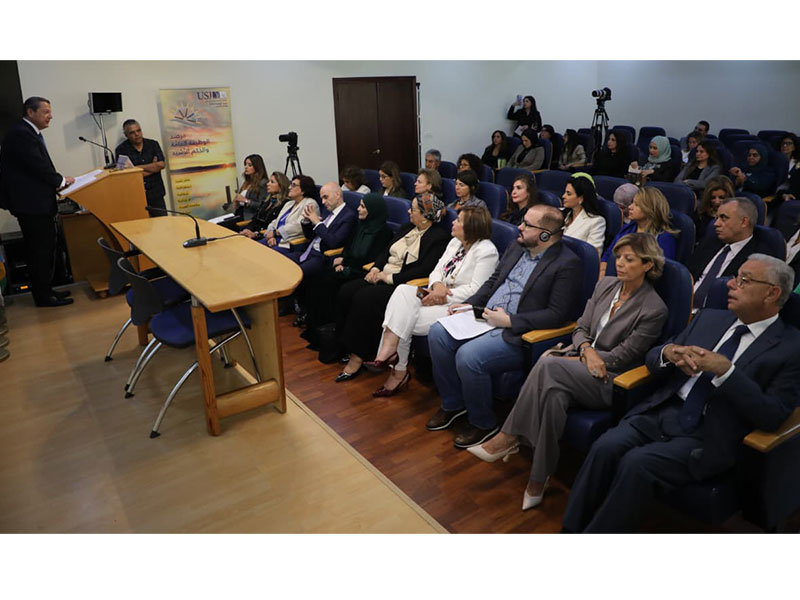
Rethinking Strategies for Good Governance
The Arab Women Organization (AWO), in partnership with the National Commission for Lebanese Women (NCLW), UN Women, and the Observatory of Public Service and Good Governance (OFP) at Saint Joseph University of Beirut (USJ), held a three-day regional conference examining how global political, economic, and social changes are affecting women across the Arab world.
Held from October 6 to 8, 2026, at USJ’s François Debbané Social Sciences Campus in Achrafieh, the conference brought together representatives of national women's institutions across Arab countries, regional and international organizations, Arab diplomatic missions to the League of Arab States, and prominent Arab women journalists.
Titled “Major Global Transformations and Their Impact on Women’s Issues in the Arab World: Toward a Renewed Strategic Vision for Good Governance,” the conference sought to identify policy responses to emerging challenges and develop practical recommendations for decision-makers.
Bridging Academic Research and Public Policy
The opening session brought together government officials, diplomats, academics, media professionals, policymakers, civil society representatives, and experts in development, human rights, and women's rights. It was moderated by Mireille Abou Khalil, a member of the Arab Women Organization’s Youth Advisory Committee.
Welcoming participants, OFP Director Prof. Pascal Monin emphasized the importance of cooperation among academic institutions, public authorities, and organizations working on women's rights and governance. He highlighted Beirut’s and USJ’s roles in providing a forum where academic research can inform public policy and strategic decision-making. Monin argued that protecting women’s rights and strengthening good governance have become essential to the resilience of states and societies facing rapid global change.
Marking the Observatory's 10th anniversary, he paid special tribute to AWO Director General Prof. Fadia Kiwan for her role in establishing the initiative and bringing academic expertise closer to public policymaking. He stressed that good governance must move beyond an institutional aspiration to become a fundamental requirement for governments and societies seeking to respond effectively to new challenges.
Rethinking Women's Rights Policies in a Changing World
Prof. Kiwan addressed the weakening of social welfare systems across the Arab region amid conflict and rapid change. She called on the international community to help end conflicts, support peace processes, and protect women's rights, noting that women are among those most severely affected by crises.
Kiwan emphasized the need to reassess existing policies and develop new approaches that reflect changing global conditions. She explained that the conference aimed to provide policymakers with research-based recommendations to better integrate women's rights into national development strategies.
She called for stronger government commitment, effective public policies, integrated approaches, improved coordination, and strategic planning that moves beyond conventional methods. Highlighting the role of public awareness and sustained dialogue in changing social attitudes, Kiwan cited Morocco’s appointment of Fatima Ezzahra El Mansouri to form a government. She pointed to the contribution of women’s organizations and civil society in building public acceptance of women in senior leadership positions, demonstrating how sustained advocacy can advance women's political participation without relying exclusively on quotas.
Developing Policies That Reflect Regional Realities
Rodrigo Montero, Director of UN Women’s regional Dare to Care program, welcomed the partnership with OFP at a time of mounting political and humanitarian challenges and growing pressure on women’s rights and governance across the region.
He called for closer alignment between public policies and institutional reforms, emphasizing that international experience should inform, rather than dictate, solutions for Arab countries. Montero stressed the importance of partnerships among universities, civil society, and women’s rights institutions in developing policies grounded in local realities.
He also highlighted the role of universities in producing research that can advance justice and institutional reform. Calling for greater representation of Arab women in decision-making positions, particularly within international organizations, he argued that meaningful participation should lead to changes in policies and institutions rather than reinforce existing structures.
H.E. Counselor Amal Ammar, Chair of Egypt’s National Council for Women and the AWO Executive Council, emphasized the importance of regional cooperation while respecting the different national experiences of Arab countries.
Drawing on Egypt’s experience with its National Strategy for the Empowerment of Women, she highlighted the importance of political support and women’s active participation in policymaking. Women, she stressed, must be recognized not simply as beneficiaries of public policies but as essential partners in their development and adoption.
Ammar also paid tribute to Palestinian women affected by the war, emphasizing the international community’s responsibility to protect women’s rights during armed conflict. She called for continued research and strategic dialogue to improve public policies and expand women’s role in shaping the future.
Challenges, Civic Participation, and Government Commitment
Speaking on behalf of the National Commission for Lebanese Women, Nathalie Zaarour, the Commission’s Secretary and a member of the AWO Executive Council, addressed the challenges facing women’s rights and meaningful participation. She emphasized the need for governments to translate national strategies into enforceable policies and concrete measures.
Zaarour also reviewed the Commission’s progress in integrating gender equality into public policy and increasing women’s participation in recovery efforts and institutional decision-making. She called for justice to remain central to policymaking, raising a fundamental question: Which principles must remain nonnegotiable in protecting women's rights and dignity amid rapid global change?
Together, the opening discussions underscored the importance of cooperation among regional organizations, national institutions, international agencies, and universities in developing effective responses to the political, economic, social, and technological changes affecting women across the Arab world.
Over three days, participants examined the impact of geopolitical shifts, economic change, international law, climate change, and social policy on women in Arab countries.
Seven Sessions Examine Global Challenges and Women's Rights
The program featured seven sessions, each followed by an open discussion.
The first day focused on three major themes:
Geopolitical Change: The Contest Between Unipolarity and Multipolarity. H.E. Ambassador Salim Badoura, Director of International Organizations Affairs at Lebanon’s Ministry of Foreign Affairs and Emigrants, addressed changing global power dynamics. The session was moderated by Joumana Sleilati, a member of the NCLW.
Challenges Facing the United Nations System: The Enforcement of International Conventions. Dr. Marie Gantous examined obstacles to implementing international agreements. Rouba Makarem, a member of the NCLW, moderated the discussion.
The Care Economy as a Driver of Social Change. Rodrigo Montero explored the role of the care economy in advancing social and institutional change, with Rouba Makarem serving as moderator.
The second day addressed three additional policy areas:
Economic Globalization, Its Retreat, and the Impact on Women. Dr. Sara Hariri, Associate Professor of Economic Policy at USJ, examined the implications of changing global economic conditions for women. The session was moderated by Mai Makzoumi, a member of the NCLW Executive Bureau.
Climate Change, Natural Disasters, and Food Security. Dr. Chadi Abdallah, Secretary-General of Lebanon's National Council for Scientific Research, addressed the effects of climate change and related crises. Sabine Saad Makary, a member of the NCLW, moderated the session.
Human Rights and Women's Rights: Moving Beyond Terminological Debates to Align Concepts and Inform National Policy. Dr. Maysoun Al-Atoum, Director of the Center for Women’s Studies at the University of Jordan, examined the importance of conceptual clarity in policy development. The discussion was moderated by Judge Samranda Nassar, a member of the NCLW Executive Bureau.
The conference concluded on October 8 with a roundtable titled “What Must Remain Nonnegotiable Amid Global Change? Defining Fundamental Principles of Human Rights and Women’s Rights.” Prof. Kiwan led the discussion, moderated by Nathalie Zaarour, before participants gathered for a final exchange.
Beyond assessing the impact of global change on women, the conference emphasized the importance of clear and consistent terminology in women’s rights discussions to support coherent national policies. Participants also exchanged experiences and good practices in social protection, the care economy, and women’s empowerment. A central objective was to develop a policy document containing actionable recommendations for decision-makers and national institutions.
The discussions were also intended to strengthen participants’ understanding of regional and international challenges, expand professional networks among young officials, academics, and experts, and inform the development of regional reference materials. These include the Arab Women Organization’s Guide to Women’s Rights and the regional roadmap for the care economy in the Arab world.
Advancing Good Governance Through Regional Cooperation
The conference formed part of the ongoing partnership between the Arab Women Organization and USJ's Observatory of Public Service and Good Governance. While AWO works to advance women’s rights and strengthen women’s participation in policies and programs across Arab countries, OFP focuses on public administration, policy development, transparency, accountability, and good governance.
By bringing these areas of expertise together, the partnership helps bridge the gap between women’s rights advocacy and institutional reform. It also provides a framework for translating research and regional dialogue into practical policies that address the challenges posed by global political, economic, and social change, while responding to the specific needs and priorities of Arab countries.
Also read: L’OFP accueille un dialogue régional sur les transformations mondiales et les droits des femmes