
 French
Memorandum of Understanding to Strengthen Good Governance and the Rule of Law
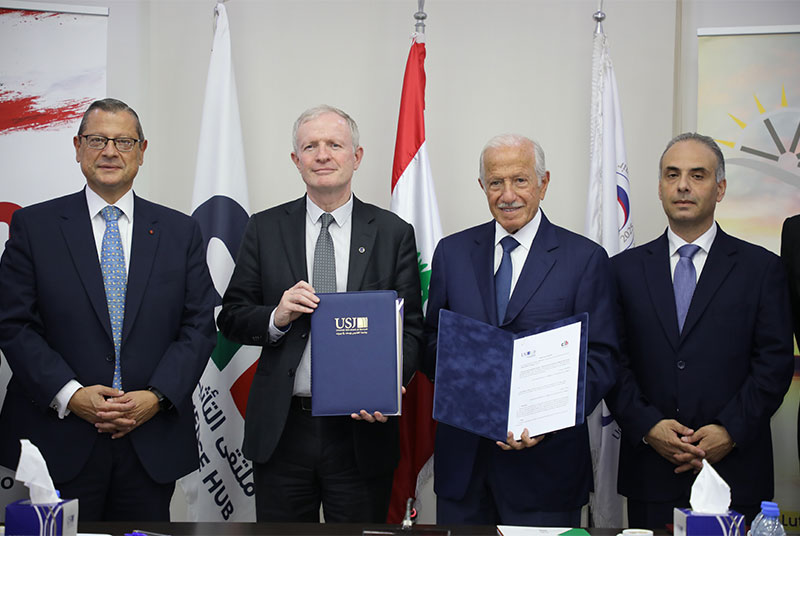
The Observatory of Public Service and Good Governance (OFP) at Saint Joseph University of Beirut and the Civic Influence Hub (CIH) have signed a memorandum of understanding establishing a strategic academic and civic partnership. The agreement reflects a shared vision for Lebanon: a sovereign state where citizenship is inclusive, public institutions are accountable, the judiciary is independent, and good governance underpins public life. Together, these principles form the foundation of the rule of law and democratic order.
Prof. François Boëdec, SJ, Rector of USJ; Prof. Pascal Monin, Director of OFP; Faysal El Khalil, President of the Civic Influence Hub; CIH Board members; and Dr. Ziad El Sayegh, CIH Executive Director, attended the signing ceremony at the USJ Rectorate.
Prof. Boëdec placed the partnership within USJ’s mission to connect academic knowledge with public action and deepen debate on Lebanon’s institutions and governance. By combining OFP’s academic expertise with CIH’s capacity for dialogue and outreach, he said, the partnership will support joint initiatives aimed at stronger institutions, responsible governance and the common good.
For Prof. Monin, knowledge should extend beyond academia and serve society and the common good. He framed the agreement as a starting point for new initiatives to strengthen state institutions and restore public trust.
El Khalil traced Lebanon’s crisis to deeper questions of statehood, sovereignty, constitutional governance, citizenship and institutional effectiveness. Building a state grounded in citizenship, he argued, requires putting people before sectarian affiliation, citizenship before group privilege and the Constitution above any competing authority.
Dr. El Sayegh shifted the focus from agreement to action, calling for applied research, policy papers, sustained dialogue, public administration reform and measurable indicators of governance and institutional performance. The goal, he argued, is to translate academic knowledge into public action and tangible results.
At the heart of the partnership is a shared belief in the value of bringing together academic knowledge, civic action and public policy influence. It seeks to help rebuild trust in institutions, strengthen a culture of accountability and citizenship, and connect academic research and debate with the real challenges facing the Lebanese state and society.
The agreement turns these priorities into a program of joint action, from roundtables, conferences and specialized seminars on governance, citizenship and justice to dialogue with policymakers, religious leaders, academics, civil society, the media, and regional and international partners. The partnership will also engage students on citizenship, support joint publications and research, and promote the exchange of knowledge and expertise.
Sustained cooperation between universities and civil society is central to the initiative, creating a pathway from knowledge to practical action, public policy and reform. The broader aim is to support a modern, effective and accountable state built on equal rights and responsibilities.
The three-year agreement includes an annual review of progress, priorities and areas of cooperation, designed to keep the partnership focused on sustained implementation and measurable progress.
This collaboration strengthens the link between the University, society and public policymaking, with a clear focus on turning knowledge into impact and supporting reform. Its broader aim is to contribute to a Lebanese state grounded in citizenship, sovereignty and good governance.
Also read: Mémorandum d’entente pour renforcer la bonne gouvernance et l’État de droit