
 French
From Lyon to Beirut: A History Still in the Making
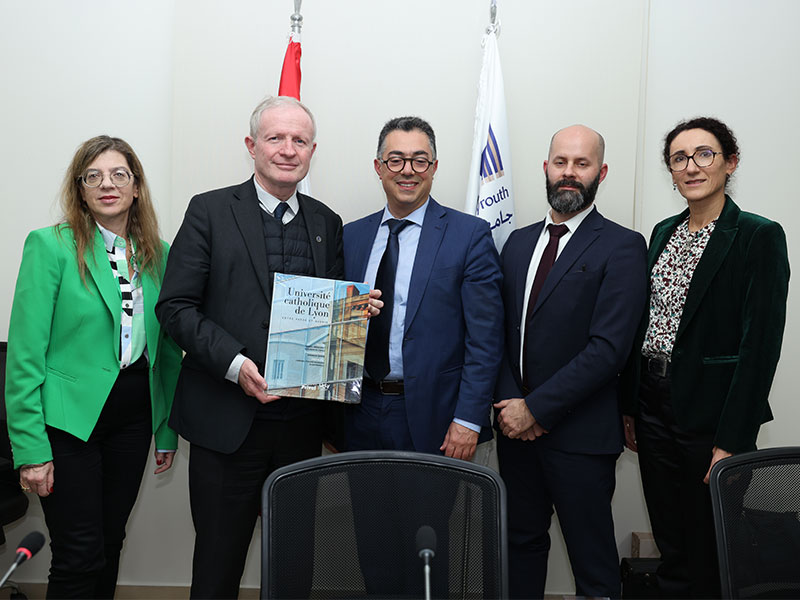
The relationship between Lyon and Beirut goes back to the founding of Saint Joseph University of Beirut (USJ) in 1875. More than a century of academic cooperation, joint projects, and personal friendships has kept that connection strong. On November 10, 2026, a delegation from Lyon Catholic University (UCLy) visited USJ’s Rectorate to reaffirm those historic ties and explore new opportunities for collaboration.
The UCLy delegation included Michel Younès, Dean of the Faculty of Theology; Julien Guinand, Dean of the Faculty of Letters and Civilizations; and Marjolaine Monot-Fouletier, Director of the Research Center in Legal, Political, and Social Sciences.
Representing USJ were Prof. François Boëdec, SJ, Rector; Prof. Carla Eddé, Vice-Rector for International Relations; Prof. Nassim Fares, Vice-Rector for Research; Lina Iskandar, Dean of the Faculty of Religious Studies; Roula Talhouk, Director of the Institute of Muslim-Christian Studies; Christian Taoutel, Director of the Department of History-International Relations; Stéphanie Jabre, Head of the Department of French Literature; Prof. Gina Abou Fadel Saad, Dean of the Faculty of Languages and Translation; and Mary Yazbeck, Director of the School of Translators and Interpreters of Beirut (ETIB).
Back to the Roots
For Prof. Boëdec, the visit carried a significance that went beyond institutional cooperation. Lyon, he recalled, has been part of USJ’s history and identity since its founding. “Reconnecting with Lyon also means returning to our roots and the original vision behind the University’s founding,” he said. But his remarks were as much about the future as the past. At a time when USJ faces the risk of isolation, he described visits from friends and partners as vital “lifelines,” reminding the University that it can count on people who “value what we do, believe in us, and want to envision the future with us.”
A video highlighting USJ’s history, mission, and commitment to Lebanese society set the tone for a broader discussion of the University’s role in the country. Prof. Boëdec reaffirmed USJ’s responsibility to serve Lebanese society as a whole, stressing that its resources must remain focused on education and young people, whom he called “Lebanon’s greatest asset for the future.”
Prof. Carla Eddé traced the relationship back to 1875, noting that the universities’ first formal agreement, signed in 2011, formalized decades of cooperation. Since then, their partnership has expanded through student and instructor exchanges, academic mobility, and joint projects, particularly in religious studies and Muslim-Christian relations. She encouraged both institutions to build on what they have achieved while identifying new areas of cooperation.
More Than a Partnership
For Michel Younès, the relationship is personal. Speaking on behalf of the UCLy delegation, he described ties between the universities as “built on friendship as much as institutional ties.”
“Choosing USJ is a heartfelt decision,” he said, reflecting on more than 20 years of collaboration in his field. He emphasized that meaningful cooperation depends on reciprocity: “A partnership must work both ways. Otherwise, it has no meaning.” Describing USJ and UCLy as “sister universities,” founded in the same year and guided by shared values, he expressed his commitment to expanding student and instructor mobility, research cooperation, and interreligious studies.
Roula Talhouk illustrated how that relationship has translated into concrete academic achievements. Since 2012–2013, USJ’s Institute of Muslim-Christian Studies and UCLy have collaborated on teaching, research, thesis and dissertation supervision, doctoral exchanges, and academic defenses. Their work has also expanded through the PLURIEL platform and several joint research projects.
New Areas of Cooperation
While the universities have a long history of working together, much of the meeting focused on what they could achieve next. Prof. Nassim Fares presented USJ’s research priorities, describing research as a “central pillar” of the University’s mission. He emphasized the need for research that responds to societal challenges, contributes to Lebanon’s development, and advances innovation, interdisciplinary work, and international cooperation.
His remarks resonated with Marjolaine Monot-Fouletier, who introduced Confluence: Sciences and Humanities, the interdisciplinary research unit she heads at UCLy. With a strong emphasis on connecting academic research with citizens and practitioners, Confluence shares USJ’s interest in research that addresses real-world concerns. “We are actively expanding our partnerships, and this visit offers an opportunity to explore new ways to work together and learn from one another,” she explained. The discussion identified vulnerability, intercultural and interreligious dialogue, and ethics as promising areas for joint research.
History, literature, and international relations also presented opportunities. Julien Guinand outlined the teaching and research priorities of UCLy’s Faculty of Letters and Civilizations, particularly history, geopolitics, languages, and Mediterranean studies. Christian Taoutel reviewed USJ’s existing partnerships with institutions in Lyon and expressed his interest in developing new projects. His message was simple: “Let’s collaborate.”
Digital humanities offered another potential avenue. Stéphanie Jabre presented ongoing research, including a project on Lebanese Francophone literature. Noting its connection to the work of a UCLy research group, she proposed expanding the project to include other literary traditions, opening the way for broader comparative research.
The discussion also covered languages and translation. Prof. Gina Abou Fadel Saad introduced the work of USJ’s Faculty of Languages and Translation and its various centers, while Mary Yazbeck presented ETIB’s academic programs and projects, including its new University Diploma in Language Engineering for Language Professions. Their presentations highlighted possibilities for academic exchanges and joint training programs.
By the end of the meeting, the discussions had identified several potential initiatives: student and doctoral mobility, jointly awarded certifications, shared courses and academic programs, collaborative research, and faculty and researcher exchanges. Both universities agreed to pursue these opportunities gradually, reinforcing established partnerships while developing new ones.
The visit ended on a personal note. Prof. Boëdec presented each of the three UCLy delegates with a personalized gift from USJ, while the visitors offered their hosts books about their university. A group photograph marked the end of the meeting, but the discussions had already laid the groundwork for future cooperation. For USJ and UCLy, the visit reaffirmed a relationship that has endured for more than a century, sustained not only by academic cooperation but also by shared values, lasting friendships, and a commitment to working together.