
 French
LIE-BAN: Connecting Generations, Building a Nation
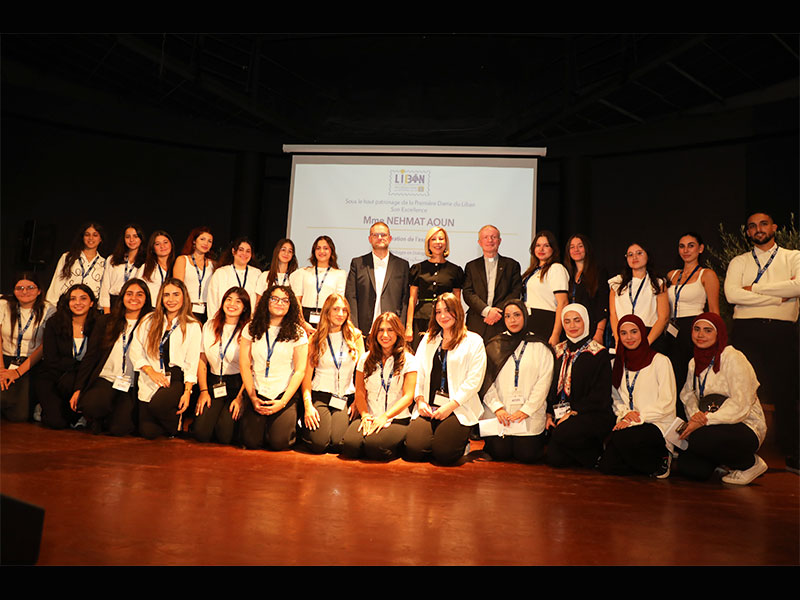
Every object has a story. It may carry the memory of a family, the skill of a craftsman, or the traditions of an entire region. In a child’s hands, that object becomes more than a piece of the past. It sparks curiosity, connects generations, and invites a new sense of responsibility. This is the idea behind LIE-BAN - Objects and Heritage in Dialogue, an exhibition inaugurated at Saint Joseph University of Beirut (USJ) on October 1, 2026, under the patronage and in the presence of Lebanon’s First Lady, Mrs. Nehmat Aoun.
The opening ceremony, held at the Pierre Y. Abou Khater Auditorium on USJ’s Humanities Campus, brought together representatives of 33 Lebanese schools participating in the educational and cultural heritage initiative led by the Lebanese Institute of Educators (ILE). Also in attendance were Prof. François Boëdec, SJ, Rector of USJ, the University’s Vice-Rectors, Deans, and Directors, representatives of national and local authorities, leaders and representatives of universities and educational institutions, partner organizations and foundations, members of the First Lady’s team and the School of Citizenship, and members of the USJ community and the wider educational community involved in LIE-BAN.
Building a Nation Through Education
The ceremony opened with the Lebanese national anthem, followed by a performance by the Anqoud Choir, conducted by ILE instructor Rose Ghorra. The harmony of different voices reflected a central theme of the event: finding common ground while embracing diversity.
ILE Director Rock El Achy raised a fundamental question: What does it take to build a nation when sharing a territory and a nationality is not enough? For El Achy, nation-building requires a willingness to confront a shared history, bridge differences, embrace common values, assume responsibility for one another, and work toward a common future. “That is precisely where education begins its mission,” he said.
Launched in 2022 amid Lebanon’s many challenges, LIE-BAN has grown into an educational initiative that uses cultural heritage to encourage dialogue, creativity, and civic responsibility. Students have rediscovered forgotten objects, interviewed their grandparents, met local artisans, and developed creative projects inspired by the stories they uncovered. Today, LIE-BAN comprises 33 schools, nearly 1,750 students, and more than 220 instructors and educational supervisors, alongside families, artisans, researchers, and partner organizations. El Achy emphasized that heritage should not simply be preserved behind glass. It should connect generations and help young people imagine the future they want to build. He described the exhibition, accompanying book, and workshops as three complementary ways of bringing this vision to life: the exhibition presents the heritage, the book preserves its stories, and the workshops allow students to carry it forward.
Speaking on behalf of the Haddad Foundation, which is supporting LIE-BAN for the second consecutive year, Hala Samaha praised the commitment of participating schools, instructors, and students. She emphasized that young people are not merely inheritors of Lebanon’s heritage but already play an active role in preserving and passing it on. Samaha encouraged students to remain curious, listen to the stories around them, and believe in their ability to help build a more united, supportive, and confident Lebanon.
Passing on Heritage Is an Act of Trust
Prof. Boëdec reflected on the deeper meaning of passing heritage from one generation to the next. He explained that inheritance involves more than handing down what previous generations have preserved. It begins with recognizing what we have received and trusting those who come after us to question, reinterpret, and enrich it. “Every act of passing something on is an act of trust,” he said. In a country where so much has been damaged, disrupted, or lost, Boëdec warned that preservation alone is not enough. Heritage must remain part of people’s lives rather than become something confined to the past.
Each object in the exhibition, he noted, represents a craft, a personal story, a family, a region, or a particular way of life in Lebanon. What gives these objects renewed meaning is the perspective of the young people who have engaged with them. He described the exhibition not simply as a museum devoted to the past, but as a place where a new generation enters into dialogue with what it has inherited. For USJ, which recently celebrated its 150th anniversary, the theme carries particular significance. Boëdec explained that the University's history is both a source of pride and a responsibility. Beyond celebrating its achievements, USJ must continually consider the graduates it prepares and the society they will help shape, remaining faithful to its mission of educating “men and women for others.”
Roots That Give the Next Generation Wings
Addressing the students, First Lady Nehmat Aoun expressed her appreciation for an initiative that brings young people together around Lebanon’s shared heritage. She described USJ as more than an academic institution, recalling its role in educating generations of public figures, thinkers, and leaders who have helped shape the country. Aoun also praised the University's continued participation in the School of Citizenship program, emphasizing that education must prepare not only capable professionals but also responsible, engaged citizens. “Citizenship is not learned within four walls; it is practiced every day,” she said.
Looking at the delegations from 33 schools across North Lebanon, South Lebanon, Mount Lebanon, the Beqaa, and Beirut, the First Lady expressed pride in seeing young people from different parts of the country united through everyday objects that preserve memories and shared values. She then turned to the challenges of the digital age, particularly the growing influence of artificial intelligence. While technology continues to transform education and society, Aoun stressed that some aspects of human experience cannot be replaced by algorithms: trust between students and educators, genuine human connection, and the values that guide people’s actions.
“Values cannot be calculated. They must be lived, practiced, and passed on. Respect for human dignity cannot be learned from an algorithm. Solidarity cannot be programmed.” She encouraged students to draw strength from their heritage as they prepare to shape Lebanon's future. “Take your roots with you; they will become your wings,” she told them. Aoun reminded the students that heritage is not something to accept passively. Each generation has a responsibility to examine, enrich, and pass it on. She urged them to honor the Lebanon they have inherited, a diverse, pluralistic country open to the world, and to recognize their responsibility for its future.
Keeping Heritage Alive Across Generations
Following the speeches, the schools and institutions that contributed to LIE-BAN were recognized for their work. Prof. Boëdec then presented the First Lady with an artwork created to mark USJ’s 150th anniversary. Reflecting the University’s history and its longstanding connection to Lebanon, the gift symbolized a shared commitment to a country USJ has served for a century and a half, and that each generation, in turn, has a responsibility to care for.
The First Lady, the Rector, and ILE Director Rock El Achy then led guests on an inaugural tour of the exhibition, exploring the objects created as part of the project. A video presentation also showcased the work of the participating schools, offering a broader look at the students’ research, discoveries, and creative contributions. The following day, the museum welcomed school groups for educational activities designed to give students a more direct experience of the heritage they had explored. These activities extend LIE-BAN’s reach while ensuring that the museum remains a living space shaped by the young people it was created for.
The heritage celebrated here is not confined to the past. It lives on, passed from one generation to the next. Beyond the 33 schools, the objects on display, the stories collected, and the voices heard that day, one message stands out, echoing El Achy’s call to the younger generation: “Be the generation that does more than inherit a country. Choose to build a nation.”
Also read: LIE-BAN : un héritage à transmettre, un Liban à construire