 French
Joining USJ: A Mission to Embrace, A Legacy to Carry Forward
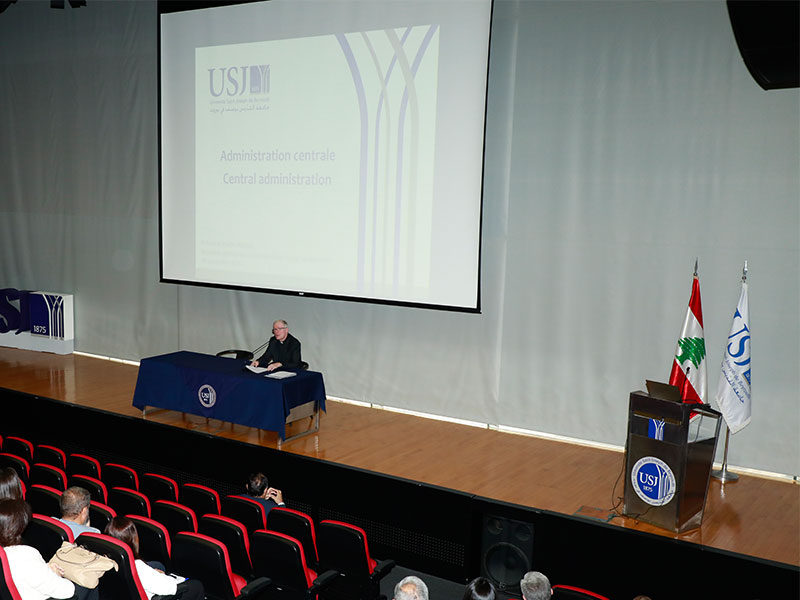
A university is defined not only by its academic achievements, but also by the people who carry its mission forward. At Saint Joseph University of Beirut (USJ), welcoming new colleagues is an opportunity to share the history, values, and sense of purpose that have shaped the institution and continue to unite its community. This commitment was reflected in a welcome and orientation event held at the François S. Bassil Auditorium on the Innovation and Sports Campus, bringing together newly appointed academic and administrative leaders, instructors, and general services staff. Opening the event, Prof. Nadine Riachi Haddad, USJ Secretary-General, welcomed participants to a morning dedicated to discovering the University from within: its history and institutional identity, the principles that guide its work, and the shared commitment to service at the heart of its mission.
Prof. François Boëdec, SJ, Rector of USJ, welcomed the new members with a message of trust and belonging. Whether longtime members of the University community or newcomers, all now shared a commitment to serving Lebanon’s young people. “We believe in you, and we are counting on you,” he said. He recalled the University’s 150-year legacy, built by generations of women and men who, through triumphs and hardships, have remained dedicated to education rooted in academic excellence and humanity.
With that trust comes responsibility. The Rector urged the new members to uphold integrity, honesty, respect, fairness, attentive listening, compassion, and courage in their decisions and relationships. For those taking on leadership roles, his message was clear: “Never forget that leadership is, above all, about service.” He also reaffirmed USJ’s Christian and Jesuit identity, rooted in the Gospel and guided by humility, openness, and service to others. This identity, he emphasized, calls for embracing differences and making the University “a place where diversity, mutual respect, and responsible citizenship thrive.”
Prof. Boëdec closed by reminding the new members that a university’s identity is not fully captured in words; it is discovered through everyday experience. “More than any grand declaration, I believe the spirit of a place, of an institution, is something we gradually come to feel as we get to know it,” he said. He encouraged them to embrace the discoveries ahead, confident that they would find the guidance and support they needed to feel at home at USJ.
Prof. Haddad introduced the new members to the University’s leadership, governance, administrative services, support systems, campus life, accreditations, and resources. More than an institutional overview, her presentation offered insight into the mission that shapes every aspect of USJ’s work: advancing knowledge through research, sharing it through teaching, and using it to serve society, especially those most in need. Together, these commitments place teaching and research within a broader mission of social responsibility.
Fr. Denis Meyer, SJ, General Chaplain, and Rock El Achy, Director of the Lebanese Institute of Educators (ILE), then explored how USJ’s values can be put into practice. Their discussion focused on discernment, accompanying others, and fostering personal growth, three principles that guide how we make decisions, act, and relate to one another. For El Achy, these values should become “a spirit that flows freely among us,” so deeply integrated in everyday life that even someone unfamiliar with them could recognize them simply by observing how members of the University community interact.
One of the morning’s most memorable reflections drew a distinction between holding a position and embracing responsibility. “We do not simply take on responsibility; we must live up to it.” A title can be held and a role performed, but true responsibility calls for something deeper: stepping into it fully, caring for what has been entrusted to us, and leaving a lasting mark. It is never ours to own, only ours to uphold for a time. “Responsibility is entrusted to us so that we may embrace it, serve it, and pass it on.” This is the essence of an Ignatian approach to mission: what matters is not following a predetermined path, but how we choose to walk it.
Fr. Meyer carried this reflection forward by turning to St. Ignatius of Loyola and the experiences that gave rise to Ignatian spirituality. “Words mean little unless we live by them and bring them to life,” he said. Drawing on the upheavals, desires, prayer, consolation, and discernment that shaped Ignatius’s journey, he encouraged participants to look beyond words and discover what gives their lives genuine meaning, freedom, and vitality.
“Pause, observe, reflect, choose, and decide.” Fr. Meyer described discernment as an “inner compass,” central to a spirituality rooted in lived experience rather than abstract ideals. This approach calls for awareness of the world around us, attentiveness to our inner lives, personal freedom, and responsible action. Ultimately, it finds expression in service: “A position is not an end in itself, but a responsibility in service of a greater mission.”
Rock El Achy returned to the three pillars of USJ’s mission: research, teaching, and service to society. “Knowledge advances through research, individuals grow through learning, and society benefits when knowledge is put to work for the common good,” he said. He also stressed that the University’s future is not set in stone. Its vision, he explained, is “a horizon we choose to make possible,” one that every member of the USJ community can help shape through the decisions they make today.
A series of interactive exercises brought USJ’s values to life, encouraging participation and creating an atmosphere of openness and shared enthusiasm. Collaboration, openness, respect, solidarity, freedom, support, and inclusion all reinforced a central idea: belonging means more than finding your place in a community; it means helping others find theirs. El Achy then invited participants to imagine USJ as a person. It would, he suggested, “be driven to grow alongside others, with a purpose greater than its own success.” It would learn from others, embrace their languages and cultures, and contribute to what they could build together.
The session left participants with a question to consider: how to exercise responsibility with purpose, make thoughtful decisions, support others, and help them grow.
From Values to Practice: Finding Your Place at USJ
The joint session was followed by three parallel workshops tailored to each group’s new responsibilities. They focused on the procedures, tools, and everyday practices that would help participants understand their roles and become part of the University community.
Deans and directors were introduced to the administrative operations supporting their leadership roles, including human resources, finance, procurement, accounting, maintenance, and information systems. The session brought together the Vice-Rectorate for Administration and relevant Rectorate departments. For instructors, the focus shifted to teaching and student learning. Rima Mawad and Mario Gharib led a workshop organized by the University Pedagogical Mission (MPU) and the Center for Digital Innovation and Artificial Intelligence (CINIA), covering course syllabi, teaching strategies, and digital learning platforms, with practical guidance on supporting students’ academic progress. Administrative staff received an introduction to USJ’s organizational structure, policies and procedures, information systems, and IT tools, with guidance from the Human Resources Office and other Rectorate departments.
While each workshop addressed different professional responsibilities, all three shared a common purpose: helping participants understand how USJ operates and contribute fully to its community. Together, the sessions connected the University’s structure, values, and sense of responsibility with the practical demands of each role, laying the groundwork for putting those principles into action.
By the end of the day, the welcome had served a purpose beyond introducing new colleagues and those taking on new roles. It had offered them a deeper understanding of what it means to belong to USJ: carrying forward a 150-year legacy, upholding the University’s values, strengthening its community, and advancing its mission. Joining USJ is not simply about finding one's place, but about making a lasting contribution. Leadership, too, is more than holding a position. It is a responsibility entrusted for a time, to be embraced, carried out with purpose, and ultimately passed on to others.