
 French
ESIB, ESIAM, ESIA, INCI, and ESAR 2026 Graduation Ceremony
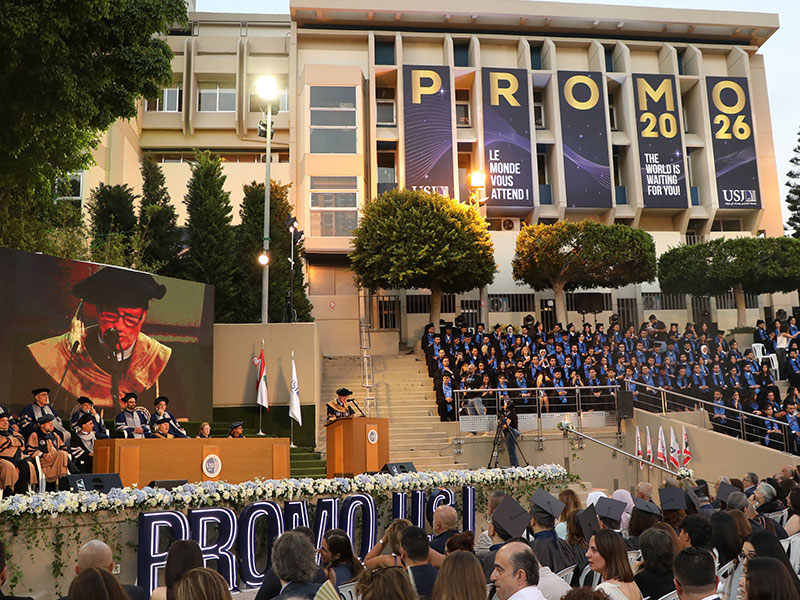
Saint Joseph University of Beirut (USJ) celebrated the graduation ceremony of the School of Engineering of Beirut (ESIB), the School of Mediterranean Agricultural Engineering (ESIAM), the School of Food Industry Engineering (ESIA), the National Institute of Telecommunications and Informatics (INCI), and the School of Architecture of Beirut (ESAR) on Thursday, July 16, 2026, at the Science and Technology Campus (CST) in Mar Roukoz,.
The ceremony was opened by Mrs. Christine Omeira Wazen, Director of the Publications and Communication Office (SPCOM), who recalled that this evening celebrated “much more than academic achievement.” Behind every diploma, she emphasized, lies a story of perseverance, challenges overcome, and dreams that are taking on a new dimension today. Praising the graduates’ courage, she congratulated them for choosing rigor and navigating periods of doubt without ever giving up.
The Rector of USJ, Prof. François Boëdec, SJ, then addressed the graduates, their loved ones, and the entire University community. Experiencing his first series of graduation ceremonies since taking office in January 2026, he shared the emotion he felt as he presented diplomas to the first graduating classes leaving the University under his mandate.
Inviting the graduates never to forget their journey, he paid tribute to their determination, while recalling that their success is the result of a collective effort. He praised the essential role of families, professors, and staff who accompanied them despite the successive crises Lebanon has endured. “Our presence here this evening is the sign of a collective achievement,” he said, calling on the new graduates to remain grateful to those who believed in them.
Addressing the future engineers, architects, and communication technology specialists, the Rector stressed the responsibility that comes with their skills. While technological advances, automation, and artificial intelligence are profoundly transforming professions, they cannot replace “respect for human dignity, listening, ethics, and a sense of responsibility.” The graduates were invited to put their knowledge at the service of the common good and to always place the human person at the heart of their decisions.
Prof. Boëdec also urged them to remain deeply attached to Lebanon, whether they choose to practice their profession in the country or pursue their careers abroad. He encouraged them to reflect on how each of them could contribute to the country’s recovery and invited them to maintain a lasting connection with their Alma Mater. Recalling that for more than 150 years, USJ has educated not only competent professionals, but also women and men guided by discernment, service, and commitment, he called on them to remain proud of their University, support it, and keep its legacy alive.
The guest of honor at the ceremony, H.E. Mr. Nizar Hani, Minister of Agriculture, renowned scientist and instructor-researcher at USJ, notably at ESIA-M, delivered a speech focused on the future. Recalling that USJ “has not only awarded diplomas, but has educated generations of women and men with a mission,” he stressed that each graduating class is called upon to respond to the challenges of its time.
According to him, the Class of 2026 is the one that will help build the Lebanon of tomorrow. In a world where knowledge is rapidly evolving, success will belong, above all, to those who continue to learn, innovate, and transform their knowledge into concrete solutions.
The Minister highlighted the complementarity of the disciplines represented at this ceremony. Telecommunications engineers, computer scientists, architects, industrial engineers, agricultural engineers, and food engineers, he explained, each contribute to building the same future. “Lebanon’s future will not be built by one discipline alone. It will be built through the complementarity of all these skills,” he said.
Addressing the ESIAM graduates more specifically, several of whom had been his students, he recalled that contemporary agriculture now relies on the convergence of artificial intelligence, drones, remote sensing, data analysis, environmental engineering, telecommunications, and innovation. He explained that the implementation of the National Agriculture Strategy 2026–2035 will require collaboration across all branches of engineering in order to build an agricultural sector that is smarter, more sustainable, and at the service of the human person.
In recognition of his scientific, academic, and national commitment, the Rector presented him with the commemorative medal of USJ’s 150th anniversary.
On behalf of the Federation of USJ Alumni Associations, Mr. Tony Hajjar then praised a graduating class that he described as a symbol of faith and resilience. He recalled that by choosing to pursue their studies in Lebanon despite the difficulties, the graduates had already demonstrated their commitment to their country. Now holding the title of “builder,” they bear, according to him, a major responsibility in rebuilding infrastructure, developing agriculture, ensuring food sovereignty, advancing the digital transition, and enhancing Lebanon’s standing. He invited them to join the USJ alumni network, “their new home,” in order to continue to uphold the values of integrity, boldness, and solidarity that characterize the University.
Taking the floor on behalf of all the graduates, Mr. Joe el-Hachem, top-ranking graduate of the Computer and Communications Engineering program, offered a reflection on the future. More important than asking where each of them will be in five years, he considered that the real question is “who will we be in five years?” Technical skills, he explained, are not enough to define an engineer: one must also know how to analyze, make decisions, assume responsibility, and put one’s expertise at the service of society.
With humor, he looked back on some memorable moments from their years of study, recalling the nights before exams, attempts to convince administrators to postpone certain assessments, and even the use of artificial intelligence to summarize hundreds of pages of course material. While these tools are, according to him, “a tremendous resource,” they can never replace personal effort, consistency, and perseverance, values that their professors constantly instilled in them.
Finally, Hachem recalled that graduates are, above all, citizens called upon to put their skills at the service of Lebanon with integrity and a sense of responsibility. He warmly thanked the parents for their sacrifices, as well as the professors and the University for their support throughout their education.
The ceremony continued with the class oath, taken by the top-ranking graduates of all institutions and programs — Marilyn Zaarour, Léa Sarkis, Joe Daoud, Sleiman Maatouk, Noël Abdel Karim, Nour Maasarani, Ribal Kasamani, Halim Sakr, Joe el-Hachem, and Jean-Paul Noun — followed by the Doctoral Oath of Scientific Integrity, taken by Maroun Ayli, Ghassan el-Helou, Mirna Haidar, and Hawra Moghniyé.
The graduates then officially received their diplomas, to the applause of their families and faculty members.
Click here for more photos
Also read: Cérémonie de remise des diplômes aux étudiants de l’ESIB, l’ESIAM, l’ESIA, l’INCI et l’ESAR-2026