
 French
Bahige Tabbara (FDSP, 1951): Farewell
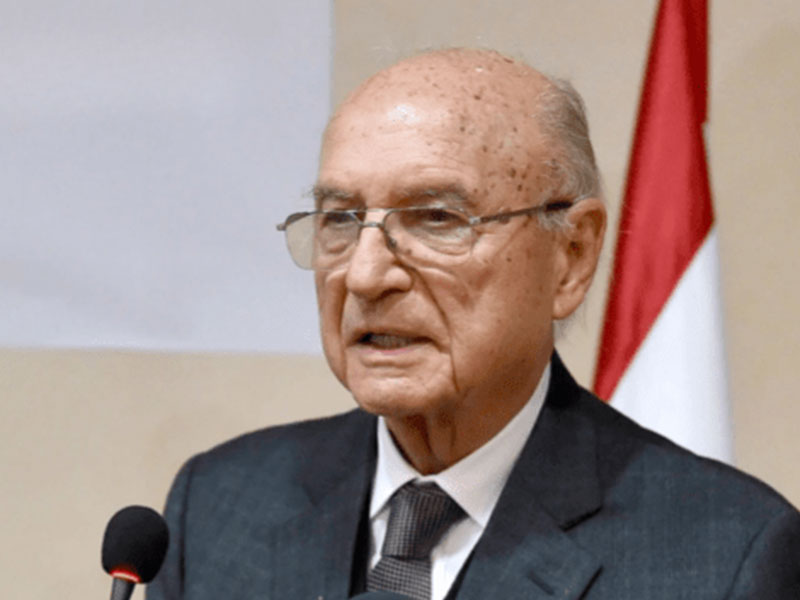
Article written by Helen Tayar, Director of the Alumni Office at Saint Joseph University of Beirut (USJ)
Saint Joseph University of Beirut bids farewell to Bahige Tabbara, member of its Strategic Board and graduate of the Faculty of Law and Political Science in 1951.
Bahige Tabbara passed away on June 26, 2026, at the age of 97. With him disappears a generation that accompanied the great transformations of Lebanon, from the pre-Civil War to the years of war, through the post-Taef period until the attempts to rebuild the country, a generation for which law and politics formed the same language, and for which public service was initially a commitment to the State.
Born in Beirut in 1929, he attended the International College before joining the Faculty of Law and Political Science (FDSP) at USJ. He obtained his bachelor’s degree in 1951, then pursued his studies in France, where he obtained a PhD in law from the University of Grenoble. Back in Lebanon, he joined the Beirut Bar Association in 1954. He practiced as a lawyer and taught at the Lebanese University (UL) and USJ.
Very early on, law occupied a central place in his career. It became a way of reading institutions, understanding their weaknesses and following their evolution.
This understanding of the country stayed with him as he entered politics. He did not seek the spotlight nor the crowds. He remained on the side of texts and institutions. Even in the exercise of power, he retained the outlook of a jurist, attentive to rules as much as to balances. His career unfolded through the country's defining periods while remaining above partisan divides.
In 1973, he joined the government as Minister of Economy and Trade. His tenure was brief, but it came at a time when the Republic was beginning to fracture under the weight of political tensions. He then resumed his activity as a lawyer during the war years while remaining closely connected to legal circles and public debate.
His trajectory took on a new dimension after the Taef Agreement, when he became actively involved in the effort to rebuild the State. During this period, he joined Rafic Hariri as a legal adviser. A working relationship was established, built on trust and constant exchanges. He occupied a unique position as a trusted jurist, often called upon to relate the requirements of law to the realities of a State in recomposition. He subsequently held several ministerial positions in successive governments, serving as Minister of Justice from 1992 to 1998 and again from 2003 to 2004, following a term as Minister of State. In 2005, he was elected Member of Parliament for Beirut.
During these years, his role went beyond the mere management of legal files. He operated at the heart of institutional balances, navigating between the demands of reform and the constraints of the political system. For him, justice was not limited to the law: it also concerned the State’s ability to reform itself, protect its institutions, and restore trust. This approach was reflected in particular in his work on the organization of the judicial system and the attention given to the functioning of its structures. He defended a constant idea: an institution stands only through the quality of those who serve it and the confidence that it inspires.
At the same time, he participated in several discussions on the role of law in public life, convinced that the stability of a country depends first and foremost on the strength of its institutions and the clarity of its rules. Behind this intellectual rigor was also a form of personal restraint, a discreet way of being present without ever occupying the public space excessively.
In 2013, he was elected president of the Arab Anti-Corruption Organization and pursued a commitment focused on issues of governance and transparency.
USJ remained a constant reference point throughout his journey. He became a member of its Strategic Board and maintained, over the years, a loyal bond with his Alma Mater, to which he remained attached in both his commitments and his reflection on public life.
His passing leaves the memory of a man of law whose journey was shaped by the country's many upheavals, but also that of a generation that sought to keep the idea of the State at the center of political life despite successive ruptures and transformations.
USJ and its Alumni community extend their deepest and most sincere condolences to his family, loved ones, and all those who had the privilege of accompanying him throughout his life.
Also read: Bahige Tabbara (FDSP, 1951) : Adieu