
St. Panteleimon is one of the most venerated physician-saints in the Orthodox church, known for uniting medical knowledge with deep spiritual compassion. Born in the late third century in Nicomedia, St. Panteleimon was originally named Pantaleon and trained as a physician under the imperial court of Emperor Maximian. His early life was shaped by a dual influence: a pagan father and a Christian mother, whose faith would later play a decisive role in his conversion.
Pantaleon’s transformation began through his encounter with the priest Hermolaus, who introduced him to Christianity. According to tradition, his faith was solidified after he invoked the name of Christ to heal a blind man, an act that not only restored physical sight but also symbolized spiritual illumination. From that moment, he devoted himself entirely to Christ, adopting the name Panteleimon, meaning “all-merciful”, reflecting both his faith and his vocation.
What distinguishes St. Panteleimon is his role as an “unmercenary physician,” a title given to saints who offered healing pro bono, without accepting any sort of payment. In a society where medicine was often reserved for the wealthy, Panteleimon treated the poor, prisoners, and marginalized, embodying a radical ethic of charity. His practice was not limited to physical healing; it was understood as a continuation of Christ’s healing ministry, addressing both bodily illness and spiritual suffering.
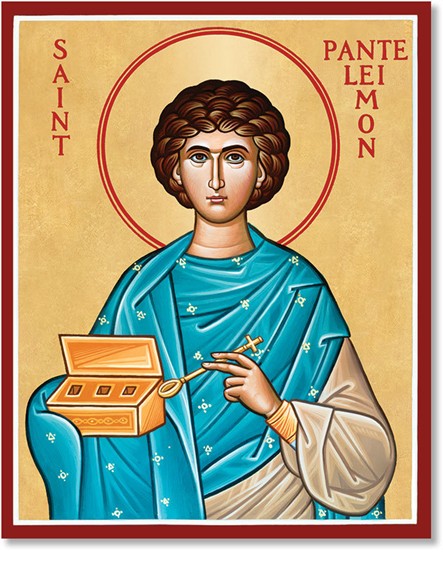
This dual role is visually expressed in Orthodox iconography, where St. Panteleimon is typically depicted holding a small wooden box and a spoon. The wooden box represents his medical kit, containing remedies and instruments used in healing. It signifies his identity as a trained physician and his practical engagement with medicine. The spoon, on the other hand, is more symbolic. While it may suggest the administration of medicine, it is also often interpreted in a liturgical context, resembling the spoon used in the Eucharist. This connection emphasizes that Panteleimon’s healing extended beyond the physical to the sacramental and spiritual realm. In this way, the icon portrays him not merely as a doctor, but as a mediator of divine grace.
His growing reputation as a healer and Christian eventually led to his persecution. During the Diocletianic persecutions (persecutions done against Christians under Emperor Diocletian), he was denounced for his faith and subjected to various forms of torture. Despite the attempts made to execute him, tradition recounts miraculous survival, reinforcing the belief that his healing power was divinely granted. He was ultimately martyred, sealing his witness with his life.
St. Panteleimon’s legacy lies in this synthesis of science and faith. He represents a model in which medical knowledge is not opposed to religious belief but is elevated by it. His life challenges the separation between professional skill and moral responsibility, presenting medicine as a vocation grounded in compassion, humility, and service.
Thus, the image of St. Panteleimon holding his box and spoon is not incidental but deeply theological. It encapsulates his identity as both physician and saint, one who healed the body through knowledge and the soul through faith, embodying the Orthodox ideal of holistic healing.