

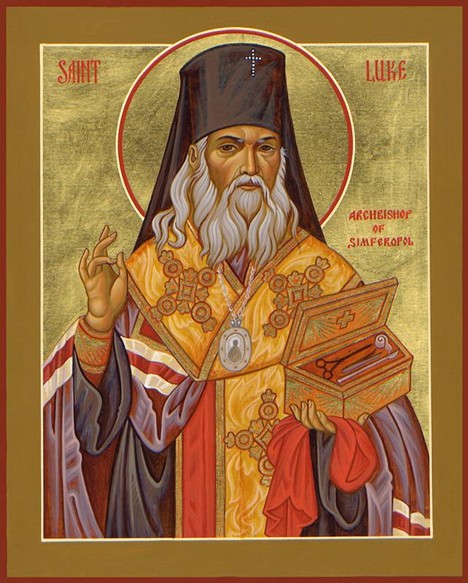
Saint Luke, born Valentin Felixovich Voino-Yasenetsky in 1877 in Crimea, led a life that uniquely united science, compassion, and deep Christian faith. Although he showed early talent in painting, his profound concern for human suffering urged him to pursue medicine instead. He graduated from the Medical Faculty of Kiev University in 1903 and quickly came to be regarded as an exceptionally skilled surgeon, especially in the field of purulent (infectious) surgery.
During the first years of his medical career, Valentin worked in rural hospitals and military medical units, where he treated the poor with remarkable devotion. He married Anna Vasilievna, a nurse who shared his spirit of service, with whom he raised four children. After Anna’s death in 1919, his vocation took a spiritual turn that would shape the rest of his life.
In 1921, he was ordained a priest, and consecrated as a bishop two years later with the monastic name Luke, honoring the Apostle Luke, the physician-evangelist. From that moment on, he carried two callings simultaneously: he remained a surgeon and professor of medicine while also serving as a pastor during a time of intense religious persecution in the Soviet Union. One of the most striking examples of this dual commitment was his insistence on keeping an icon of the Virgin Mary in the operating room. He famously declared that he would never operate without her presence, saying that surgery requires not only skill and knowledge but also divine guidance. This conviction became a hallmark of his medical practice and spiritual identity.
Saint Luke endured three arrests, interrogations, and years of exile in Siberia, where he faced harsh conditions, hunger, and threats. Yet he continued to perform surgeries, even in exile, often operating with limited tools in remote villages. He also authored a widely acclaimed medical textbook, "Essays in Purulent Surgery," which would later earn him the Stalin Prize for outstanding scientific contribution, despite being a persecuted clergyman.
During World War II, he was appointed chief surgeon in a military hospital, saving thousands of wounded soldiers. After the war, he became Archbishop of Simferopol and Crimea, where he continued to serve the Church and treat patients, even when glaucoma left him nearly blind. Known for his gentleness, courage, and unwavering integrity, he comforted the sick and defended Christian teachings in the face of government opposition.
Saint Luke died on June 11, 1961. His funeral drew enormous crowds, and people openly sang hymns in defiance of Soviet authorities. In 1996, he was canonized by the Russian Orthodox Church, and today his relics in Simferopol attract pilgrims from around the world. Numerous healings and miracles are attributed to his intercession.
Saint Luke’s life stands as a compelling testament to the harmonious coexistence of science and faith. He showed that a physician can heal not only the body but also the soul, and that courage, love, and service can shine even in the darkest times.