 French
USJ Research Podcast: New Voices, New Directions
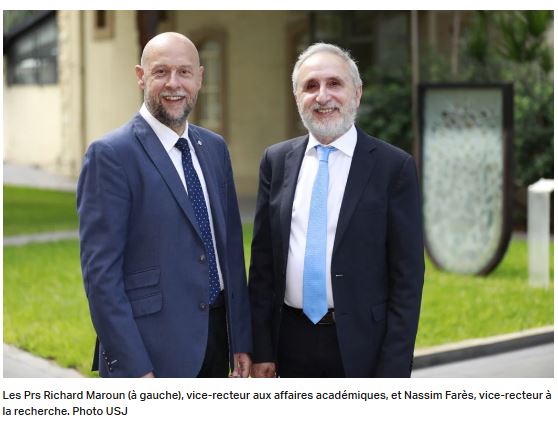
What drives research at USJ, and where is it headed? The University’s new podcast, Les voix/voies de la recherche, brings its research priorities and emerging developments to a wider audience. The series opens with interviews featuring directors of USJ’s research centers, units, and laboratories before shifting its focus to individual researchers, offering listeners a closer look at the work being conducted across disciplines. “This first phase will introduce audiences to our main research priorities, the questions being explored, and the emerging trends in each field,” says Prof. Nassim Fares, who became Vice-Rector for Research at the start of the academic year. The podcast started in late July with Prof. Richard Maroun, now Vice-Rector for Academic Affairs, who had launched the initiative during USJ’s Research Days in June while serving as Vice-Rector for Research. The second episode is scheduled for October.
Across the humanities and social sciences, medicine, health, science, and technology, important research often receives little attention beyond academia. “Much of this work remains within laboratories, academic journals, and the research community,” says Prof. Maroun. “Our aim is to bring it to a wider audience, helping people understand the questions researchers are addressing, what their findings reveal, and how those findings can benefit society.” For Maroun, research excellence must go hand in hand with effective communication. “Producing high-quality research is no longer enough. We also need to explain its significance and demonstrate its impact,” he says. The podcast will also examine how research can fuel innovation, support technology transfer, create economic value, and address societal challenges.
Connecting Researchers and Decision-Makers
Beyond showcasing USJ’s research, the podcast aims to build connections among researchers, the public, and potential partners. Within the University, it seeks to encourage greater exchange across faculties and research disciplines. “We hope this initiative will strengthen collaboration across faculties, encourage the sharing of resources, and open up new avenues for interdisciplinary research,” says Prof. Fares. For the wider public, Les voix/voies de la recherche offers a closer look at the work being carried out at USJ and its relevance to everyday life. “We want to narrow the distance between research and the public, making it easier to understand and showing what it contributes to people's lives,” he adds. Another priority is to reach businesses and public institutions that may be unaware of research with potential applications in their sectors. For Prof. Maroun, the podcast’s ultimate ambition is to connect the academic community with partners who can help turn research findings into practical solutions. “A scientific discovery can lead to innovation, technology transfer, collaboration with industry, or a solution to a real societal need,” he explains. “This is particularly important in Lebanon. USJ’s strength lies in the breadth of its academic disciplines and its ability to bring together complementary expertise to address the major challenges facing society.”
For Prof. Fares, Lebanon’s ongoing crises make the initiative particularly timely. “Research must remain connected to the realities of the society it serves.” Upcoming episodes will address some of Lebanon’s most pressing challenges, from air, water, and soil pollution to waste management, renewable and sustainable energy, the economic crisis, food security, and major public health concerns. “By examining these issues through the lens of research, we hope to deepen public understanding, contribute to informed debate, and explore possible solutions,” Fares explains.
Strengthening Civic Responsibility
Making complex research understandable to nonspecialists, without compromising scientific rigor, will be one of the podcast’s main challenges. “If scientific knowledge remains confined to specialists, we are falling short of a fundamental responsibility as a university,” says Prof. Fares. The series will encourage researchers to discuss their work in clear, engaging terms while preserving the accuracy and depth of their findings. “When researchers are passionate about their work and recognize its wider significance, communicating science becomes a rewarding experience,” he explains. “It offers a chance to share knowledge, spark curiosity, and help people better understand the world around them.” Future episodes may also be accompanied by photographs, videos, illustrations, and other visual resources to help explain complex topics. Fares also sees potential to build on the series through public engagement activities. “We could organize workshops open to the public, giving participants a chance to explore scientific discoveries through hands-on activities and direct interaction,” he suggests.
For Prof. Fares, the ambition behind Les voix/voies de la recherche extends well beyond showcasing the University’s research. The series seeks to spark public interest in research, deepen understanding of its role in everyday life, and highlight its contribution to social progress. Just as importantly, he hopes it will strengthen public recognition of the need to support and sustain research, especially in times of crisis. “Research deserves recognition, support, and protection because investing in knowledge means investing in our collective future,” he says. His final message reflects the broader purpose of the initiative: “The stronger our research, the better equipped our society will be to develop, overcome challenges, and shape its future.”
Watch the podcast series: https://www.youtube.com/watch?v=bm_x9Y7Fpx8