
 French
USJ Economics Students Step into Economic Diplomacy
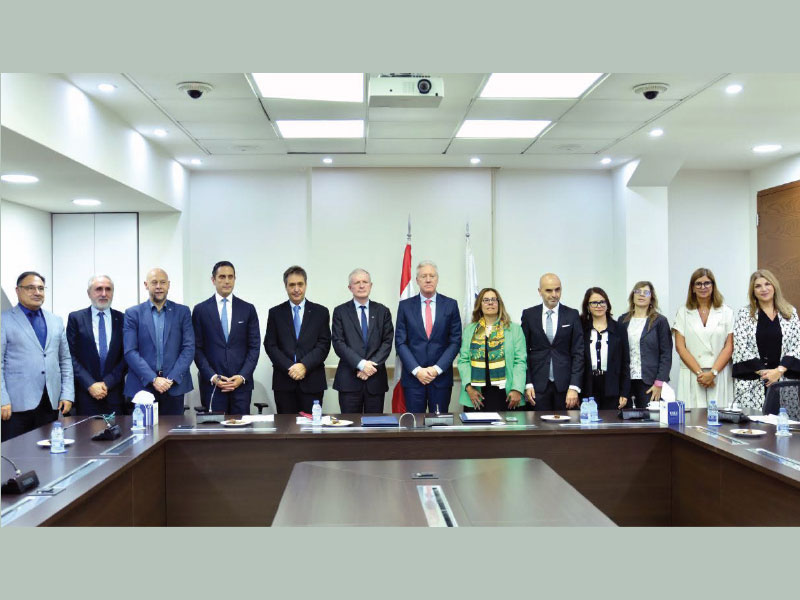
Saint Joseph University of Beirut (USJ) and Lebanon’s Ministry of Foreign Affairs and Emigrants signed a memorandum of understanding (MoU) on October 7, 2026, to bridge the gap between academic learning and professional practice in economic diplomacy.
Starting next semester, students at USJ’s Faculty of Economics (FSE) will be able to complete eight- to twelve-week internships at the Ministry, contribute to applied research projects, take part in simulated international negotiations, and draft economic and public policy briefs.
“Classroom learning provides the theoretical foundation, but practical experience is equally important. This agreement gives students the opportunity to put their knowledge into practice,” says Prof. Jean-François Verne, Dean of FSE.
Students will gain practical experience at the Directorate and Department of Economic Affairs and develop a deeper understanding of its operations and the demands of diplomatic service. For Prof. Verne, the agreement addresses a persistent challenge in higher education: bridging the gap between academic instruction and professional practice. Building on FSE’s applied courses, including economic diplomacy, the internships will familiarize students with the institutional and operational dimensions of their field. The initiative may also support preparation for the competitive entrance examination for the economic diplomacy program, while creating potential pathways into Lebanon’s diplomatic corps, including positions within the Ministry’s Department of Economic Affairs. “This is ultimately what makes the partnership so valuable,” Prof. Verne emphasizes. Equally important is the development of professional competencies, from analysis and synthesis to negotiation, decision-making, and communication. “Economic diplomacy demands precision in both thought and expression. Students must be able to present their arguments clearly to colleagues, in French or English. These skills are fundamental to the profession.”
Addressing Lebanon’s Economic Priorities
The agreement will also encourage students to examine pressing economic and trade issues facing Lebanon. According to Prof. Verne, the Ministry could benefit from international economics case studies prepared by first-, second-, and third-year students, as well as research conducted by FSE instructors and PhD candidates.
The projects could examine Lebanon’s place in the global economy and the policies needed to drive its recovery. “Any discussion of Lebanon’s economic recovery must take into account the regional landscape and international relations, particularly in light of developments across the region and beyond,” Prof. Verne explains. Potential research topics range from economic policy and relations with international financial institutions to bilateral economic partnerships, trade agreements with regional and European partners, and strategies for attracting foreign investment amid political instability.
Prof. Verne, however, emphasizes that understanding economic diplomacy begins at home. “Students need to understand how local stakeholders can work together. We must first confront our domestic challenges and find ways to build greater unity. Economic diplomacy extends beyond international relations to the structures of the domestic economy.” He also stresses that effective economic diplomacy demands more than negotiation skills: it requires a commitment to fair and ethical agreements that serve the interests of all parties. Ultimately, he sees the partnership as an opportunity to equip students with the knowledge and skills to contribute to Lebanon’s reconstruction.
“This agreement serves a purpose beyond USJ and FSE. Our students will become part of Lebanon’s professional and civic life, and some may help build the Lebanon of tomorrow. I believe public institutions should recognize this potential and engage more closely with USJ,” he concludes.
Also read : La Faculté de sciences économiques de l’USJ connecte ses étudiants aux réalités de la diplomatie économique