
 French
Research Transforming Society

OLJ / By Joanne NAOUM, June 4 2026
At a time when societies are going through profound technological, environmental, economic and human transformations, one question arises: what should be the role of universities and research today? Long perceived as a space for the production and transmission of knowledge, universities are now called upon to become real agents of societal transformation, capable of enlightening decisions, accompanying changes, and responding to major contemporary challenges.
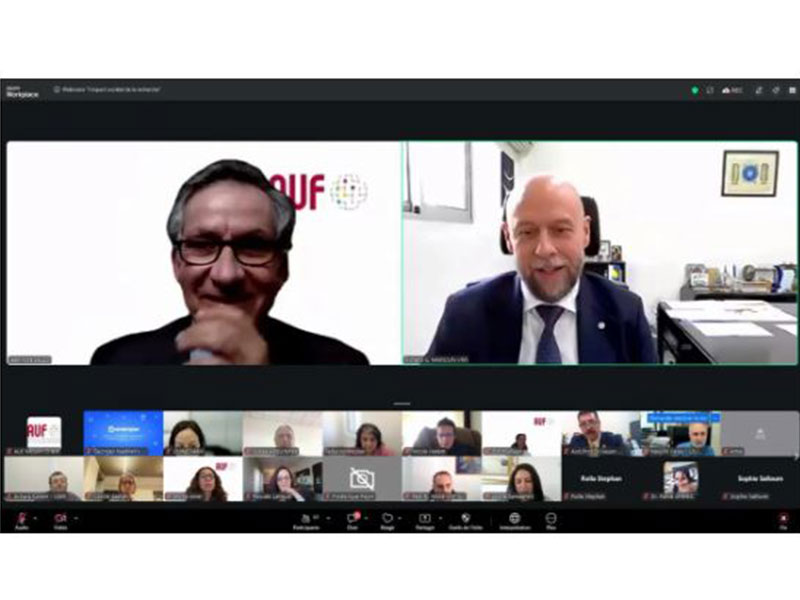
This was the reflection at the heart of the webinar “The societal impact of research,” organized on May 21 by the Regional Conference of Rectors of the Middle East (C2R) and the Agence universitaire de la francophonie (AUF) in the Middle East. Throughout the interventions, a strong idea emerged: research can no longer be thought of only in terms of scientific publications or academic excellence. Its true impact is demonstrated when knowledge concretely improves human life, feeds public policies, stimulates innovation, and contributes to building a fairer, more enlightened, and more sustainable society.
This vision is fully in line with the guidelines of AUF’s 2026-2029 strategy, which places the promotion of research, its social usefulness and its role in development at the heart of its priorities. In a region affected by crises and upheavals, universities are called upon to strengthen their commitment to society and rethink their missions beyond traditional frameworks.
“In the Middle East, the impact of research is measured by its ability to improve living conditions, strengthen the resilience of societies and contribute to public policies in the face of multiple crises in the region,” insists Jean-Noël Baléo, Regional Director of AUF for the Middle East. Beyond scientific production and technological innovation, research also plays a key role in the development of critical thinking, dialogue and social cohesion. Universities and research centers are called upon to become areas of cooperation, interdisciplinarity and social transformation, promoting trust and connection between communities and countries.
For Pascale Lahoud, a cultural entrepreneur and researcher in the philosophy of science in Lebanon, this transformation has become a necessity. She calls for a “multidirectional communication” between the university and society, capable of accompanying the disruptions that are redefining our era. According to her, higher education must now participate in a true “civilizational preparation” in the face of technological and social changes to come.
“It is necessary to put our academic efforts at the service of a mission complementary to our usual missions, which consists in teaching, researching and acting so as to protect the conditions of an authentically human life for the generations that we have the duty to form,” she claimed.
Beyond scientific production, Pascale Lahoud insists on the flow of knowledge, the ethical responsibility of research and the need to reflect on the human consequences of technological advances, especially in the context of artificial intelligence and environmental crises.
Finding a balance between scientific excellence and social usefulness
The issue of the concrete impact of research was also addressed by Fadia Homeidan, director of the Office of Grants and Contracts (OGC) at the American University of Beirut, who highlighted the mechanisms for the valorization and transfer of scientific results. Through the theme “From laboratory to market: technology transfer,” she recalled that academic research is not limited to generating knowledge, but can become a direct driver of innovation, economic growth and social transformation. She particularly highlighted the strategic role of the collaborations between universities and industry, incubators and science communication, in converting academic discoveries into real solutions that meet society’s needs. She explained that the valorization of research promotes job creation, supports the creation of new startups and strengthens the entrepreneurial culture while helping to solve urgent societal issues. In a particularly powerful speech, Mounir Fakhry Abdelnour, President of the Board of Trustees of Université française d’Égypte and former Egyptian Minister of Tourism, Trade and Investment, recalled that “the question is no longer just: what do we know? But also: what is this knowledge for and how does it transform our societies in a positive way?”
Faced with the upheavals related to artificial intelligence, climate, economic and social crises, he believes that the university can no longer remain “an ivory tower” isolated from its environment. It must become an actor of development, a space for dialogue and a driver of social transformation.
According to him, “the real challenge is to find a balance between scientific excellence and social usefulness.” For, he stressed, “the university is not only transforming the economy, it is also transforming citizens, and through them, society as a whole. Its deepest impact is human and cultural.” He also warned of the immense responsibilities of universities in view of artificial intelligence. Training students in new tools is no longer enough. Institutions must also develop ethical thinking, protect scientific integrity, and prevent technologies from creating new social divides between those who master knowledge and those who experience it.
In this perspective, the university of tomorrow will need to strengthen interdisciplinarity, increase the bridges between exact sciences, human sciences, and social sciences, and develop closer ties with businesses, public authorities, NGOs, hospitals and cultural institutions.
“The university must learn to listen to society as much as to speak to it,” said Mounir Fakhry Abdelnour. Deep down, he says, “the ultimate mission of the university is no longer just to convey knowledge, but to help society better understand the world and better prepare its future.”
Also read: Quand la recherche transforme la société
