
Religious Perspectives on the Environmental Crisis in Lebanon
When Faith Becomes a Responsibility: Caring for Lebanon’s Common Home
The trees that grow around us, the water that sustains us, the soil beneath our feet, all will one day be entrusted to generations who never knew us, yet who will inherit the consequences of the choices we make today. Perhaps this is where environmental responsibility truly begins: in understanding that caring for the Earth means caring for a future we may never see, but that we are already helping to shape.
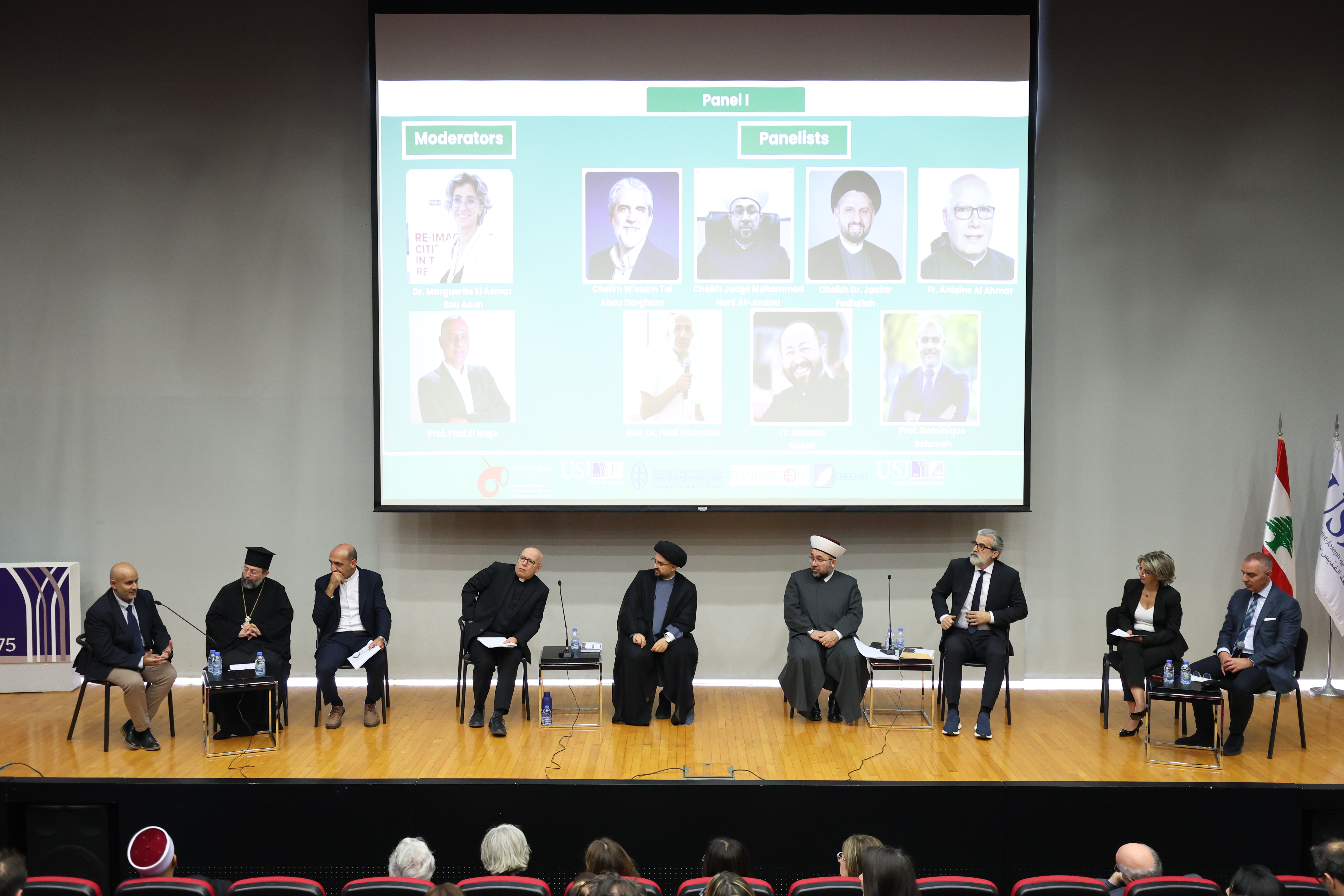
It was around this shared responsibility that Saint Joseph University of Beirut (USJ) hosted the conference “Religious Perspectives on the Environmental Crisis in Lebanon” on October 29, 2026, at the François Bassil Auditorium, at the Innovation and Sport Campus. Organized through the Faculty of Religious Studies (FSR), the Chair of “Fondation Diane” for Education on Eco-citizenship and Sustainable Development (CEEDD), the Faculty of Sciences, and the Eastern Mediterranean Environment Research Center of the Faculty of Letters and Human Sciences, in collaboration with Danmission and the Middle East Council of Churches, the conference brought together religious representatives, academics, environmental experts and institutional actors to explore how faith, ethics and knowledge can turn environmental awareness into responsibility, and responsibility into action.
A crisis that speaks to conscience
Opening the conference, Dr Marguerite El Asmar Bou Aoun, Assistant Professor of Philosophy of Religion at USJ, stressed that while pollution, climate change, water scarcity and biodiversity loss demand scientific expertise and effective institutions, the environmental crisis is also profoundly human and ethical. In Lebanon, religious communities can therefore play an important role in shaping attitudes and behaviors. “Ultimately, whatever our religious traditions, we share the environment we inhabit. Its protection is therefore a shared responsibility,” she said.
For Pr Fadi El Hage, Delegate of the Rector for Professional Development and Chairholder of the Fondation Diane Chair, that responsibility begins with education, a space where meaning can meet behavior, faith can meet responsibility, and knowledge can lead to action. “Let us make this conference the beginning of work that we commit to pursuing, not the end of words we know how to say,” he urged. “Our children deserve more than to be taught why life must be protected; they deserve to see us protecting it.”
Dr Lina Iskandar Hawat, Dean of the Faculty of Religious Studies, called on faith and reason to assume responsibility together in protecting our “common home.” Turning to the Lebanese cedar, celebrated in the Psalms yet increasingly threatened by drought and disease, she gave that responsibility a deeply local meaning. “When the cedar falls ill, it is not only a forest that declines; something in our identity is wounded,” she said, reminding participants that protecting the land is also about protecting a shared heritage and a shared future.
From shared values to shared action
Mrs. Kirsten Auken, Regional Director for the Middle East at Danmission, described stewardship of creation as a responsibility that transcends religious differences, calling for faith leaders, scientists, policymakers and young people to work together for a better future. With younger generations set to inherit today’s environmental challenges, she urged participants to turn reflection into commitment: “Let us ensure that the work we do today does not end in this conference room but grows into lasting action.”
Pr Michel Abs, Secretary General of the Middle East Council of Churches, stressed that Lebanon’s environmental crisis touches health, agriculture, water, energy, natural resources and human dignity. Religion cannot replace scientific expertise or the State, he noted, but it can help shape conscience and remind society that creation is “a gift, a trust, and a responsibility toward both present and future generations.” He called for a movement “from environmental concern to environmental responsibility, and from responsibility to sustained action.”
The message of Pr François Boëdec, s.j., Rector of USJ, delivered on his behalf by Dr Lina Iskandar Hawat, placed this responsibility within the University’s mission and the Ignatian tradition. “The Earth is our common home. It sustains us, holds our collective memory and bears the imprint of our choices. We have received it as an inheritance. It is up to us to decide what we will pass on to future generations,” he stated. For USJ, environmental concern is inseparable from concern for human dignity and the future. “Caring for our common home is not an optional addition to faith. It is a tangible expression of love.”
Protecting nature, rebuilding trust
H.E. Mette Thygesen, Ambassador of Denmark to Lebanon, evoked the beauty of Lebanon’s natural heritage alongside the pressures threatening it, from forest fires and water scarcity to waste and damage caused by recent wars. “These are not abstract problems,” she stressed. “They shape people’s health, their livelihoods, and their hope for the future. Faith communities, she added, can speak about care for creation in a language reaching “people’s hearts, not only their minds.” By acting together, they can simultaneously protect nature and build trust between communities.
Closing the opening session, Ms Ramza Jaber, representing Dr Tamara El Zein, Minister of Environment, delivered a message centered on responsibility toward generations yet to come. Returning to the image of planting a tree whose shade we may never enjoy, the Minister called for a legacy that goes beyond preserving natural resources: “Perhaps the most beautiful thing we can leave to future generations is not only more trees, cleaner water and safer natural resources, but also a different awareness, one that makes respect for nature part of our respect for ourselves and for others.”
In Lebanon, where economic, social and environmental crises intersect, war has caused further damage to agricultural land, vegetation and natural resources, particularly in the South. Environmental protection, the message stressed, is therefore not separate from Lebanon’s recovery, but an essential part of it. Ethical responsibility must also translate into institutional action, sustainable resource management, effective oversight, community participation and science-based decision-making.
What will we leave behind?
The dialogue continued through a plenary panel and three parallel workshops devoted to religious education and the environment; faith-based organizations as actors of environmental action; and religious leadership, ethics and environmental governance, followed by an afternoon synthesis of their conclusions and avenues for cooperation.
Across the day, one conviction emerged: protecting Lebanon’s environment requires laws, policies, science and institutions, but also a deeper sense of responsibility toward the world we share. Because the water we drink, the air we breathe and the land we cultivate belong to no single community. A tree planted today may shelter someone we will never know. A river protected today may sustain a generation we will never meet. The choices made now will outlive those making them.
And so the question remains: What will we leave behind?