
 French
 Arabic
The Ministry of Foreign Affairs and Emigrants and USJ Strengthen Economic Diplomacy Cooperation
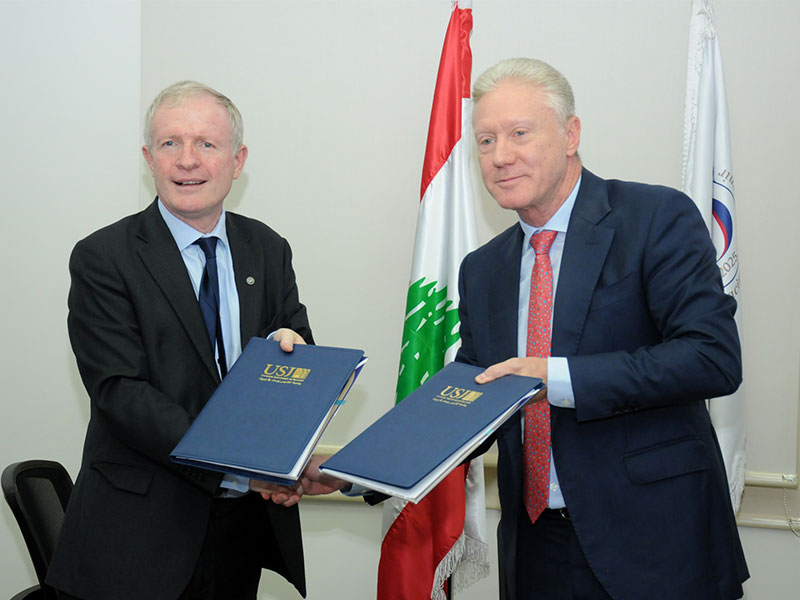
Saint Joseph University of Beirut (USJ) and Lebanon’s Ministry of Foreign Affairs and Emigrants have signed a memorandum of understanding (MoU) to strengthen cooperation in economic diplomacy by connecting academic education, applied research, and government practice.
The agreement was signed at USJ’s Rectorate in Beirut by H.E. Youssef Raggi, Minister of Foreign Affairs and Emigrants, and Prof. François Boëdec, SJ, Rector of USJ. The ceremony was attended by Prof. Jean-François Verne, Dean of the Faculty of Economics (FSE), and representatives of both institutions.
For Raggi, a USJ alumnus, the occasion held personal significance as he returned to his alma mater in his capacity as Foreign Minister.
In his remarks, he emphasized the growing importance of economic diplomacy, noting that foreign policy now extends beyond political and security matters to include trade, investment, energy, technology, international financial institutions, food security, and supply chains.
He explained that the partnership will give FSE students firsthand exposure to the Ministry’s operations, particularly its Directorate of Economic Affairs. Students will have the opportunity to apply their academic knowledge, better understand the demands of diplomatic work, and explore potential careers in Lebanon’s diplomatic corps.
Raggi stressed that modern diplomacy requires professionals with diverse expertise and the ability to understand global developments and defend Lebanon’s interests. He also highlighted the value of the University’s research and analytical capabilities in supporting the Ministry’s work.
He expressed hope that the agreement would lead to broader cooperation between the Ministry and Lebanese universities, encouraging young people to engage with public institutions and pursue careers in public service.
Prof. Verne outlined how students will benefit from the partnership through internships at the Ministry, applied research projects, the preparation of economic reports and policy briefs, and simulated international negotiations. These activities will help them develop analytical, communication, negotiation, and decision-making skills. Students will also work on issues directly relevant to Lebanon, including bilateral economic relations, international trade agreements, and relations with international financial institutions.
Verne concluded: “We aim to prepare economists who understand the national and international context and can apply their expertise to inform decision-making.”
In his address, Prof. Boëdec thanked Minister Raggi for attending the ceremony and for his commitment to strengthening cooperation between the two institutions.
He emphasized that the agreement reflects USJ’s mission as a university actively engaged with society and the wider world. Beyond providing academic knowledge, USJ seeks to prepare students to understand their environment, take on responsibilities, and contribute to the common good.
He also stressed the importance of investing in Lebanon’s youth amid the country’s ongoing challenges. Describing the talent of young Lebanese women and men as a source of hope, he called for greater efforts to equip them with the skills and opportunities to build their futures and, whenever possible, contribute to their country.
Boëdec closed his remarks by thanking those who helped make the partnership possible.
The Ministry will host FSE students for eight- to twelve-week training programs at its Directorate of Economic Affairs. Participants will gain practical experience with the Ministry’s operations and develop skills relevant to their future careers.
The agreement also provides for applied research projects on economic issues relevant to the Ministry’s work, including Lebanon’s bilateral economic and trade relations and international economic and trade agreements.
The MoU is valid for three years and may be renewed by mutual agreement.