
 French
Health Law and Bioethics: A USJ-Lyon 3 Dual Degree Open to Everyone
L’Orient-Le Jour | Thursday, April 16, 2026
The dual degree offered by the Faculty of Law and Political Science at USJ and the Faculty of Law at Jean Moulin Lyon 3 University, dedicated to health law and bioethics, trains professionals to better understand the legal and ethical issues of contemporary medicine.
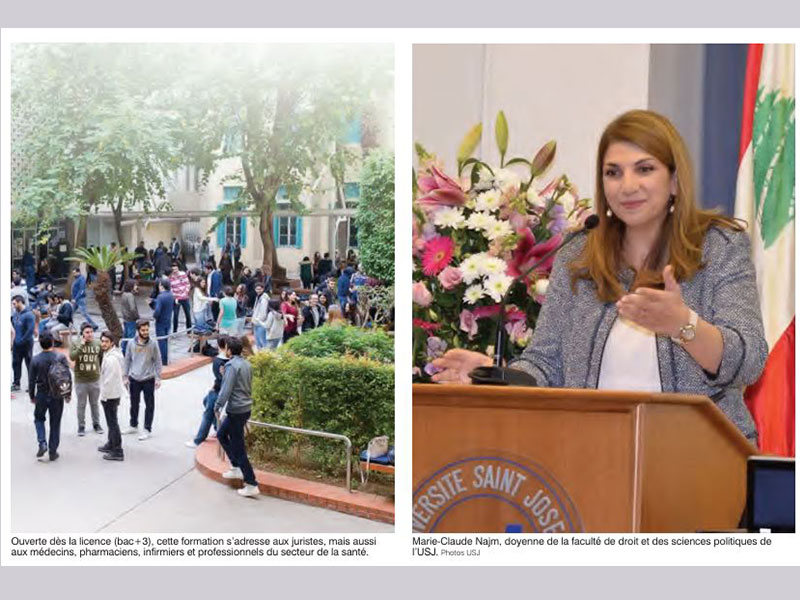
Taking into account the increasing importance of health issues and the legal and social questions they raise, “this program, launched a year ago, provides a solid foundation of knowledge necessary to understand the key issues facing the Lebanese and French healthcare systems,” explains Marie-Claude Najm, Dean of the USJ Faculty of Law and Political Science. “The advantage of this program is that students will hold two university diplomas, one awarded by the Faculty of Law at USJ, entitled Health Law and Bioethics, and the second diploma, Law, Expertise and Healthcare, awarded by the Faculty of Law at Jean Moulin Lyon 3 University,” explains Guillaume Rousset, Professor of Private Law at Jean Moulin Lyon 3 University and Director of the Centre de recherches en droit et management des services de santé (CRDMS). “A Lebanese student will not be able to obtain the French diploma without also obtaining the Lebanese diploma, as the two are closely linked in order to encourage a comparison between the two healthcare systems.” While this program is certainly intended for legal professionals, it is also open to any student holding a bachelor’s degree (three years of higher education), regardless of their discipline: law, medicine, pharmacy, business, insurance, etc., as well as to learners and current or future professionals who already work in the healthcare sector and need to deepen their legal knowledge of health law and bioethics: physicians, pharmacists, nurses, executives in healthcare institutions, pharmaceutical companies or health insurance companies, managers, hospital lawyers, etc. “It is the multidisciplinary nature of the program, bringing together legal professionals and healthcare professionals and combining the social, human, and medical sciences, that makes this dual degree so distinctive,” says Marie-Claude Najm. “Medical activity in the broadest sense of the term is at the heart of this program, but viewed through the legal perspective of healthcare,” she further stresses.
A Program Adapted to the Constraints of Professionals
As this program is particularly intended for professionals who have already begun their careers in the healthcare field or who are entering the professional world, the schedule has been adapted to accommodate their professional commitments. “All courses are taught in person and given over three days per month: Thursday and Friday from 4 p.m. onward, and all day Saturday,” explains Ms. Najm. “They are complemented by conferences addressing current topics, interactive seminars with French and Lebanese professionals, as well as practical work on health law and bioethics.” The courses are divided into four modules taught over two semesters: introduction to health law, patients’ rights, bioethics, and medical liability law. Twenty credits are allocated to the University Diploma in Law, Expertise and Healthcare, offered by the Faculty of Law at Jean Moulin Lyon 3 University, and 20 credits to USJ’s University Diploma in Health Law and Bioethics. “The first module, introduction to health law, provides an understanding of the organization of the Lebanese healthcare system, which differs from the French system: hospital and pharmaceutical organization, hospital law regulations, professional orders, the compliance system, issues of professional ethics, forensic medicine, and the role of the forensic physician and its importance during a judicial investigation. The second module concerns the status and rights of patients: how to inform the patient, obtain their consent to continue treatment or discontinue care, the right of access to medical records, professional confidentiality, telemedicine, clinical trials, decision-making when the patient is no longer in full possession of their mental faculties, issues concerning minors and persons with mental disorders, etc. The third module covers all issues relating to bioethics, where the law is called upon to address developments and advances in medical science and genetics and to set the limits of what is permitted in terms of embryo research, organ procurement for donation, artificial insemination, termination of pregnancy, as well as end-of-life issues: determining the time of death, coma, euthanasia, the legal status of the deceased body, and respect for burial. The fourth module concerns all issues of liability: civil liability — including the question of assessing physical or moral harm —, criminal liability, and disciplinary liability.” “The advantage of this dual degree is that French professors come here to Lebanon to teach courses on French law, which complies with European standards and differs from Lebanese law, giving students the opportunity to compare and contrast European practices with Lebanese law,” explains Guillaume Rousset, Professor of Private Law at Jean Moulin Lyon 3 University.
Mastering the Legal Environment in Hospital Settings
“This diploma opens up new perspectives in various hospital fields since mastering the legal framework is essential to the management of these institutions. However, these perspectives depend on the type of audience,” notes Mr. Rousset. The first group consists of practicing healthcare professionals who need to master the legal environment and come to acquire legal skills and expertise that they can then apply in their professional setting. The second group consists of professionals, no longer from the healthcare sector but from the legal field, who wish to acquire a specialization in health law that they can subsequently apply, if necessary, when changing activities or positions: lawyers or corporate lawyers. The third group consists of students in initial degree programs who, thanks to this specialization in health, will be able to apply for a Master’s degree in France or Lebanon, or abroad more generally. Marie-Claude Najm concludes: “By opening this dual degree to our students, whose first cohort has just achieved excellent results, we are enabling them to study in Beirut while offering them valuable international exposure and an excellent quality of education delivered by a teaching team composed of academics, legal practitioners, and healthcare professionals, both French and Lebanese. At the end of their program, they will be better equipped to understand the legal dimensions of the healthcare system and to master the professional environment in the daily practice of their profession.”
Also read: Droit de la santé et bioéthique : un double diplôme USJ-Lyon 3 ouvert à tous les profils