
 French
17th Edition of the USJ Research Days
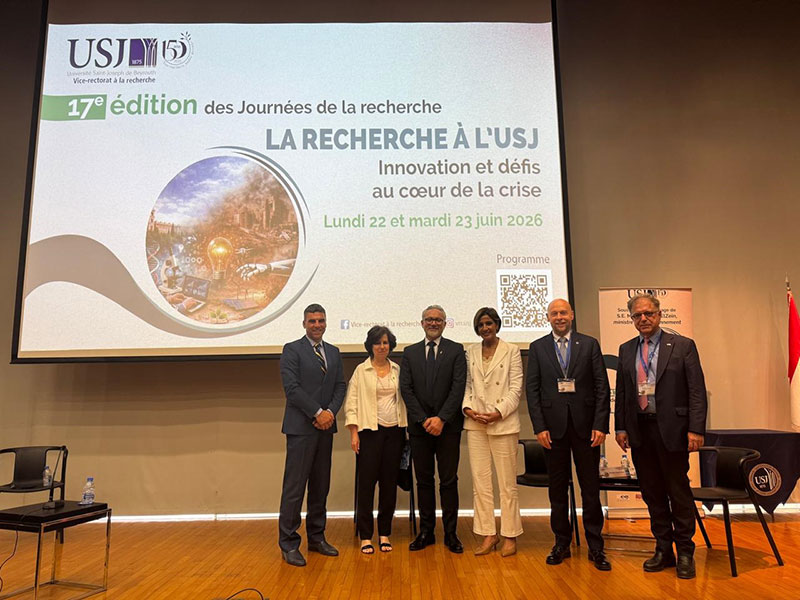
In a Lebanon facing multiple crises, Saint Joseph University of Beirut (USJ) reaffirmed its commitment to scientific research that brings meaning, innovation and hope, on the occasion of the 17th edition of the USJ Research Days, organized on June 22 and 23, 2026 at the Innovation and Sports Campus, under the high patronage of H.E. Ms. Tamara El Zein, Minister of Environment.
Under the theme “Innovation and challenges at the heart of the crisis,” this edition brought together researchers, academics, PhD candidates, students, public decision-makers and institutional partners around the same conviction: research remains one of the most powerful levers for understanding the changes of our time, responding to contemporary challenges and contributing to Lebanon’s recovery.
The inaugural session, moderated by Mrs. Pamela Emanuelle Krause, doctor of philosophy, set the tone for these two days by highlighting the need for an interdisciplinary approach to the complexity of current crises. She recalled that “everything concerning humans is dispersed in all sciences, and all sciences must be connected,” advocating for research capable of “connecting what is separate” to better understand the major issues of our time.
Then, Prof. Richard Maroun, Vice-Rector for Research at USJ, emphasized the essential role of research in turbulent times. “Research is never more essential than when societies are in crisis. It provides answers, informs decisions, creates opportunities and nurtures hope,” he said. Reviewing the progress made in recent years, he presented the main initiatives implemented by the Vice-Rectorate for Research. He also stressed the importance given to the next generation of researchers and to assisting young researchers, recalling that these Research Days brought together nearly 80 oral presentations and 15 poster presentations covering all disciplines of the University.
The Regional Director of the Agence Universitaire de la Francophonie (AUF) in the Middle East, Mr. Jean-Noël Baléo, praised the central place given to research in the national debate despite the accumulation of crises in the country. Referring to the support programs implemented by AUF in partnership with CNRS-Lebanon, he recalled the importance of preserving the Lebanese scientific capital and encouraging vocations among the younger generations. According to him, “Lebanese scientists have come out of the posture of astonishment that was able to prevail for a few years” and now have an essential role to play in the process of the country’ recovery. “Your expertise is necessary, it is essential for the recovery and even the sovereignty of the country,” he said.
Mrs. Marion Eynard, Deputy Advisor for Cooperation and Cultural Action and Deputy Director of the Institut français du Liban, reaffirmed France’s commitment to the development of scientific research in Lebanon. She introduced the various mechanisms for scientific cooperation and support for PhD candidates and young researchers, notably the PHC CEDRE, SSHN, SAFAR programs and scholarships. Emphasizing the need to strengthen international collaborations and interdisciplinary approaches, she recalled that “science remains above all at the service of humanity,” especially in times of crisis when research helps to inform decisions and build sustainable solutions.
In his speech, Prof. François Boëdec, SJ, Rector of USJ, highlighted the distinctive responsibility of universities in the current context. He stated that “crises should not lead to renunciation, but to more creativity, cooperation and commitment.” In a particularly impactful speech, he added that “the last word must always be to life.” The Rector also pointed out the progress made by the University in terms of research, notably the strengthening of its international visibility, the development of strategic partnerships and the increase of its interdisciplinary collaborations. He stressed the importance of quality research, useful to society and faithful to the humanistic values of the institution. “We must pursue research of excellence, but also research that preserves the sense of humanity, places ethics at the heart of innovation and contributes to building a more sustainable, just and united future,” he said.
Guest of honor at this edition, H.E. Ms. Tamara El Zein delivered a profound reflection on the contemporary transformations of scientific research. She warned against the tendencies of research subjected to exclusively market or quantitative logics. Referring to the concepts of progress, innovation and ethics, she urged researchers to remain guided by human values and the common good. She stressed the moral responsibility of scientists in the face of potentially destructive uses of their discoveries. “It is becoming essential for every scientist to denounce the misuse of his work in the service of evil or the violation of the rights of life,” she said, before recalling that “science is meant to build and not to destroy.”
The inaugural session was also marked by the introduction of a new research podcast project at USJ, which aims to give greater exposure to researchers, their work and their impact on society. As every year, the Research Days were also an opportunity to pay tribute to several researchers whose careers illustrate the scientific excellence of the University. The “Emerging Talents” awards were given to Associate Prof. Amal Dabbous Soubra (USJ Business School) and to Dr. Amer Sebaaly (Faculty of Medicine). The “Outstanding Career” awards were presented to Dr. Louis Hardan (Faculty of Dental Medicine) and Dr. Tony Sayah (Faculty of Science). Finally, the Rector’s Distinction was awarded to Prof. Joseph Kattan for his contribution to the development of clinical research and oncology within USJ and Hôtel-Dieu de France.
These two Research Days offered a particularly rich program including a panel discussion on the impact of the crisis on research in Lebanon, a conference on mental health in a turbulent world, as well as numerous scientific sessions in medical, human, social, and technological sciences. A session dedicated to alumni researchers and an exhibition of scientific posters also made it possible to promote the diversity and vitality of the research conducted at USJ.
Through this 17th edition, USJ reaffirmed its conviction that research, when driven by excellence, ethics, openness and commitment to the common good, remains an essential driver of resilience, transformation and hope for Lebanon and the region.
Click here for more photos.
Click here for the program.