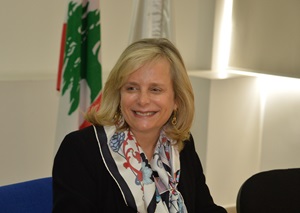
Message from the Dean, Prof. Patricia Rached
Critical Thinking in the Age of the Society of the Spectacle and Emerging Technologies
In his book The Society of the Spectacle (1967), Guy Debord highlighted the danger of a world in which representations of reality become more present and influential than reality itself.
Today, social networks media, and technological transformations are profoundly reshaping our daily lives, increasing the flood of messages and information while weakening the foundations of human relationships.
It has become difficult to distinguish between information and opinion, or between truth and falsehood, and even to fully enjoy the present moment without feeling the need to display it before the gaze of others. Gradually, we may find ourselves living “for others” rather than allowing ourselves the time to live “with them.”
In this constantly changing context, we resonate with Edgar Morin’s assertion that “the first form of resistance is resistance of the mind” (Morin, 2024). This idea highlights the need to rethink the aims and purposes of education to prepare citizens capable of reflection and analysis, able to critically examine sources, exercise informed and discerning judgment, and preserve a degree of authenticity in a world dominated by a culture of constant visibility and the worship of images.
Developing critical thinking does not mean questioning everything, nor does it mean retreating into a state of constant suspicion. Rather, it consists of helping learners build an independent, responsible mindset that is open to others, enabling them to engage in dialogue and cooperation and to collectively address the challenges of the contemporary world. The complexities of this reality also remind us that no individual, no matter how knowledgeable, can encompass everything alone, which calls for the development of collective intelligence capable of responding to the major educational issues facing our societies today.
Dear students, dear educators,
Educational institutions are, more than ever, required to support learners in their engagement with media, social networks, and emerging technologies. The challenge lies in transforming schools into spaces for meaning-making, fostering critical thinking, and strengthening a culture of dialogue in response to contemporary challenges. This vision is consistent with the work of Mireille Cifali (2019), which emphasizes the importance of preserving, amid ongoing media and technological transformations, an educational relationship grounded in care for others, sound judgment, and shared responsibility in building the common good.
Pr. Patricia Rached - HDR
Dean of the Faculty of Education

 French
 Arabic