
Chinese language Programs
Chinese language for Adults and Teenagers
At our institute, Chinese language courses follow the New HSK 3.0 program, designed to help students develop their skills and succeed in the official HSK / HSKK proficiency exams. The program is designed for learners at all levels of Chinese language proficiency, from beginners to intermediate and advanced students. To ensure appropriate placement, applicants with prior knowledge of Chinese are required to complete a placement test, through which their language proficiency is assessed and they are enrolled in the level that best matches their existing skills and learning needs.
The first semester runs from September to December, and the second semester is from January to May. Classes are normally offered in person; an online option is also available if enough students register to form a class.
The HSK 1 level is offered for beginners. It can be completed in one semester and a half with two weekly sessions, or in three semesters with one session per week; this applies equally to the HSK 2. HSK 3 level can be completed in 4 semesters (2 academic years) with one weekly session.

Upon successful completion of the HSK1 (3.0) course, students will develop standard Mandarin pronunciation and oral proficiency. HSK 3.0 Level 1 (Task‑based Syllabus) includes 30 communicative tasks. Apart from daily survival situations, the curriculum covers new topics such as family, hobbies, health, appointments, study, invitations, expressing preferences and refusals, and talking about the weather. Learning materials are upgraded from single sentences (HSK 2.0) to short dialogues and mini‑texts (for HSK 3.0).
HSK2.0 Vs HSK3.0
In March 2021, the Ministry of Education introduced the Chinese Proficiency Grading Standards for International Chinese Language Education, which officially came into effect on July 1, 2021. Under these new standards, the HSK 3.0 proficiency system is organized into three levels and nine bands:
Elementary Level: Bands 1-3
Intermediate Level: Bands 4-6
Advanced Level: Bands 7-9
The Chinese Proficiency Test (HSK) 3.0 will officially launch on December 13, 2026. The upgraded test will provide Chinese language learners, teachers, and educational institutions with a more accurate assessment of Chinese language proficiency.
We take HSK1 as an example to explain the detailed difference between HSK2.0 and HSK3.0.
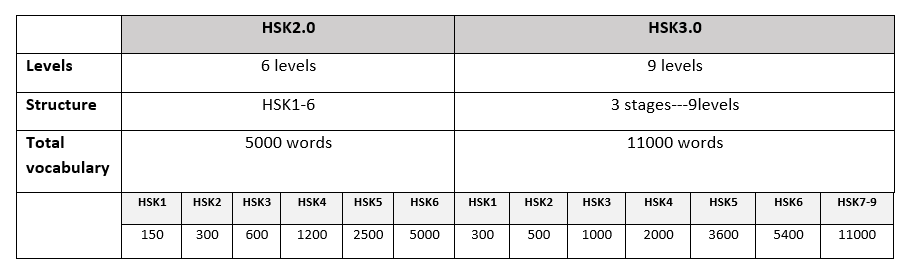
The differences are following:
1. Teaching of Phonetic System (Pinyin)
The old HSK 2.0 Level 1 textbook provides systematic Pinyin teaching from Lesson 1 to Lesson 5 in the main course book, including initials, finals, tones and syllable‑spelling practice as core classroom content.
By contrast, the new HSK 3.0 Level 1 main textbook does not contain dedicated Pinyin lessons. Pinyin exercises only appear in the workbook. Therefore, teachers are required to add Pinyin instruction and practice in class.
2. Doubling of the Vocabulary
The old HSK 2.0 Level 1 has 150 words, all high‑frequency survival vocabulary and basic words for daily life such as food, clothing, housing and transportation. For Chinese characters, only recognition is required. There is no mandatory writing requirement. All test papers are printed with Pinyin, so learners may rely fully on Pinyin.
The vocabulary of HSK 3.0 Level 1 expands to 300 words, doubled compared with the old version. Besides basic survival words, it adds words for study, social interaction, simple feelings and opinions. For Chinese characters: 246 characters for recognition and 50 characters for handwriting. Learners are required to write Chinese characters and gradually move away from Pinyin dependency.
3. Scenarios and Task‑based Mode (the biggest conceptual difference)
The old HSK 2.0 Level 1 covers a narrow range of topics, limited to basic survival phrases: greetings, self‑introduction, shopping, asking for the time and asking for directions. Most test items are word matching and single‑sentence judgement. Questions are based on isolated sentences, with almost no short texts or dialogues.
HSK 3.0 Level 1 (Task‑based Syllabus) includes 30 communicative tasks. Apart from daily‑survival situations, new topics are added: family, hobbies, health, appointments, study, invitations, expressing preferences and refusals, talking about the weather. Learning materials are upgraded from single sentences to short dialogues and mini‑texts. The teaching goal shifts to communicative output. In addition, learning evolve from single sentences (HSK 2.0) to short dialogues and mini-texts (HSK 3.0), supporting more practical and contextualized communication.
The Business Chinese course introduces beginners to essential speaking and listening skills for commercial contexts. Students learn practical expressions for daily communication with suppliers, covering topics such as price inquiries, reservations, customs, and shipment details. By semester’s end, they can confidently handle routine business conversations. This program is designed to be completed within one semester. The schedule features two weekly sessions, with each session running for 1 hour and 15 minutes.

Our Chinese language courses for Children offer a fun, interactive, and engaging learning experience for young learners. Through songs, stories, games, and hands-on activities, children develop language skills, build confidence, and discover a love for the Chinese language and culture.
The HSK 3.0 Programs for Children follow the same curriculum and certification standards as our adult tracks. Each level (HSK 1, HSK 2) is taught over four semesters (two academic years), with one 1 hour 15 minutes session per week. This carefully paced approach allows children to develop their language skills gradually while building a strong foundation in Chinese through consistent practice and support.

Upon successful completion of the HSK1 course, students will develop standard Mandarin pronunciation and oral proficiency. They will achieve lexical acquisition by mastering approximately 70 essential vocabulary words, enabling basic interpersonal communication and the ability to engage in simple daily conversations. Students will gain the thematic expression necessary to communicate effectively about foundational topics such as greetings, introductions, expressing gratitude or apologies, dates, and age while building descriptive literacy to clearly express basic ideas using simple situations or visual prompts. Finally, the curriculum emphasizes character recognition, equipping students to read all new vocabulary independently without Pinyin alongside developing the skills to write select Chinese characters.